Why Mechanical Devotion Cannot Lead to God
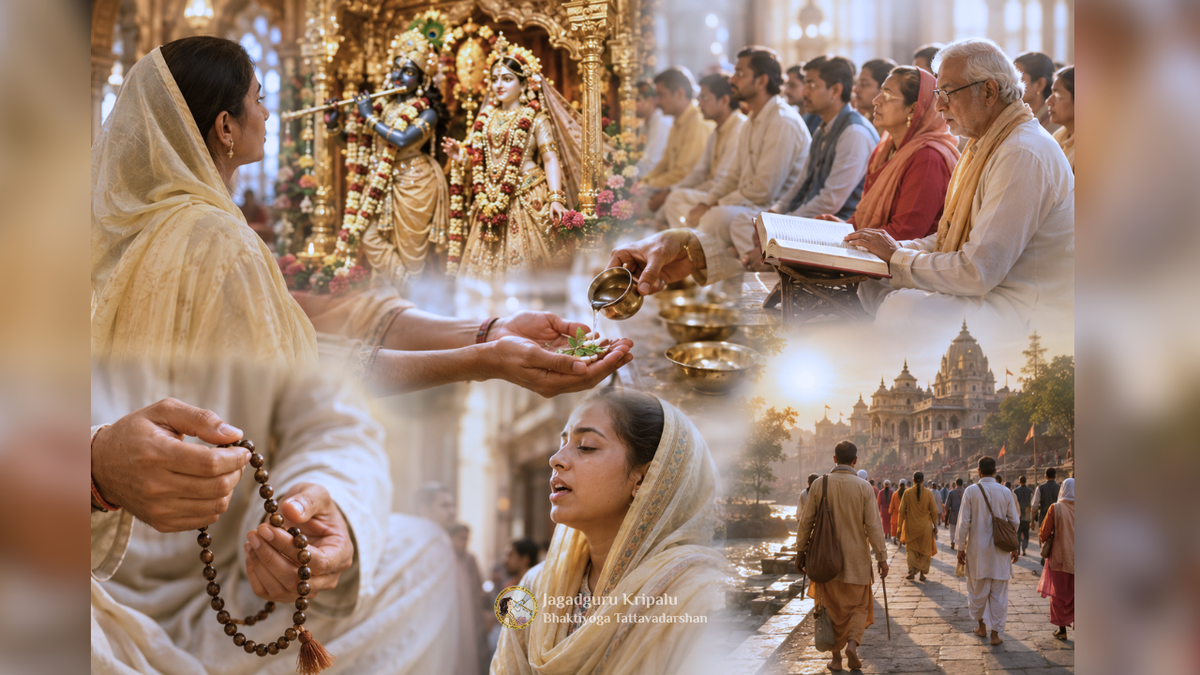
Bhakti is of many kinds. The Bhāgavatam itself describes as many as thirty kinds.
Broadly speaking, however, bhakti is primarily of two kinds:
- Bhakti performed with the mind's loving attachment (anurāga)
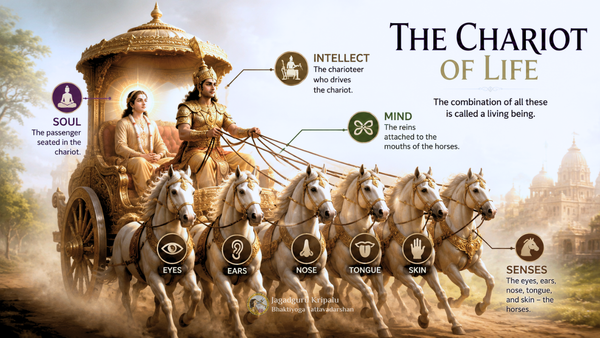
- Bhakti performed through the ten senses - the five gyānendriyas (organs of perception) and the five karmendriyas (organs of action).
Most people practice only the second kind.
They go to the temple to see the Deity with their eyes. They listen to the Vedas, Purāṇas, Bhāgavatam, and Ramayan with their ears. They receive tulsi leaves and charanamrit in their mouths. They chant on beads with their fingers, recite God's names with their tongue, and undertake pilgrimages with their feet.
Throughout India and across the world, countless forms of devotional practice are performed through the senses.
But among all these, the bhakti performed with the loving attachment of the mind is the very life-force (prān) of devotion.
You are two: the soul and the body.
The body certainly has value. If the soul of a God-realized saint dwells within a body, then -
Anuvrajāmyahaṃ nityaṃ pūyeyeyeaṅghri reṇubhiḥ.
God Himself says, "I walk behind My devotee so that the dust of his feet may fall upon Me and purify Me."
Even in the materal world, people rush to see a prime minister, president, famous singer, celebrated actor, or any highly respected person. The body receives honour because of the person dwelling within it.
But once the soul departs, even the closest relatives - wife, mother, or son - wish to remove the body immediately. No one wants to keep it in the house. People even dread to see a corpse, for within a few days it begins to decay.
Thus, it is the soul that gives importance to the body.
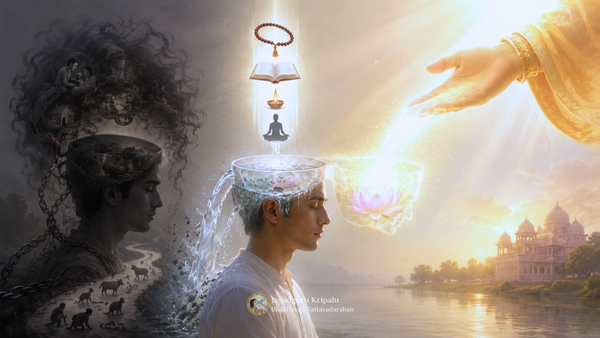
Similarly, God takes note only of the devotion performed by the mind. Mere physical acts of devotion, performed without the mind's attachment, carry no value in the realm of God.
Misled by the ignorant, people keep their minds absorbed in worldly affairs while their fingers mechanically move over prayer beads or while they repeatedly write "Ram Ram" on paper. They perform devotion through the senses and expect to attain Golok after death.
But after death, one receives only what one has already attained while living.
Just as examination results merely reveal what was already written on the answer sheet months earlier, death simply reveals the state of mind that has already been cultivated through one's actions.
Every action - good or bad - every attachment to God or to the world, shapes the condition of the mind. The extent of your worldly attachment is itself the measure of your mind's impurity.
Likewise, the degree of your detachment (vairāgya) from the world reveals the depth of your attachment (anurāga) to God.
Suppose today you lose Rs.100 and feel distressed. Later, as you make spiritual progress, you remain calm even on losing Rs. 500 thinking, "It was never truly mine." As detachment deepens, one eventually reaches such an elevated state that even the destruction of the entire world leaves the mind undisturbed. Even the death of a dearly loved relative does not shake one's inner equilibrium.
When a person reaches this state, complete detachment from the world has been attained.
This is the true measure by which one should examine oneself.
Similarly, suppose someone showers you with countless insults, calling you lustful, angry, greedy, foolish, or sinful. Those statements are true, so why become upset? Simply smile. Feeling hurt by the truth will not improve you. Improvement comes only by honestly accepting one's faults.
Thus, devotion performed with the mind is true bhakti.
Therefore, while singing sankirtan, always keep your mind absorbed in Roopdhyan - loving meditation of the divine form of God.
Recommended books by Jagadguru Shri Kripalu Ji Maharaj related to this topic: