Who is Shyamsundar?
You must know the identity of the One with whom you wish to establish a relationship.
yasmāt paraṃ nāparamasti kiñcit, yasmānnāṇīyo na jyāyo'sti kaścit -
Shri Krishna is the One beyond whom nothing else exists.
A question was posed in the Vedas:
Ka: paramo deva:? - Who is the Supreme Power?
Kasya jñānena akhilaṃ jñātaṃ bhavati? - By knowing whom, does nothing else remain to be known? Who is the One, after attaining whom, there remains nothing greater to be attained?
The Vedas declare -
kṛṣṇo ha vai paramaṃ daivataṃ -
Shri Krishna is the Supreme Truth. There is nothing beyond Him. By knowing and attaining Him, nothing else remains to be known or attained.
He is endowed with shad-aishvarya, the six divine opulences, described as 'bhag'. The One who possesses them is called Bhagavān -
aiśvaryasya samagrasya dharmasya yaśasaḥ śriyaḥ। jñānavairāgyayoścaiva ṣaṇṇāṃ bhaga itīraṇā॥
Shri Krishna possesses these six opulences.
The Gopis and Gopas serve him. He is the Lord of Vrindavan. He alone is the Supreme One.
Mahavishnu is Shri Krishna's personal expansion. We, the individual souls, are parts of Shri Krishna, but we are not His personal expansions. We are parts endowed with Shri Krishna's power, called jiva-shakti, whereas Mahavishnu and other expansions are endowed with His personal power, called swaroopa-shakti. Such is the vast difference. We, souls, have always been under the influence of Māyā, whereas God's personal expansions (svāshas) have never been, nor can they ever be, overpowered by Māyā. The swaroopa-shakti governs all individual souls, while God's personal expansions govern the swaroopa-shakti. Such is the distinction.
So, the first expansion of Shri Krishna is Mahavishnu.
yasyaikaniśścasitakālamathāvalambya jīvanti lomavilajā jagadaṇḍanāthāḥ।
viṣṇurmahān sa iha yasya kalāviśeṣo govindamādipuruṣaṃ tamahaṃ bhajāmi॥ (Brahma Samhita)
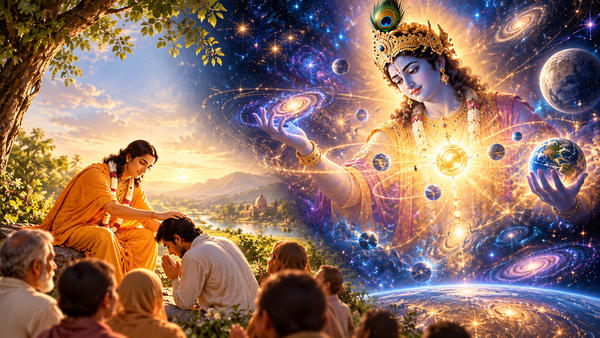
Innumerable universes come into existence with one breath of Mahavishnu. When He withdraws His breath, innumerable universes dissolve.
Brahma, Vishnu, and Shankar are infinite in number because each universe has its own three presiding deities, and there are innumerable universes. Your universe is very small. Its Brahma has four heads. Similarly, there are Brahmas with eight, one hundred, one thousand, one hundred thousand, or even ten million heads. The number of heads a Brahma has corresponds to the size of his universe.
Mahavishnu is the presiding Lord of these innumerable universes. He is an expansion of Shri Krishna.
Mahavishnu lies down in the Kāranāranav, the causal ocean. He is known as Kāranāranavashāyī Vishnu. From Him, Garbhodashāyī Vishnu is born (from whose naval emerges a lotus flower on which the creator Brahma is born, and who enters into each universe created by Mahavishnu). From Garbhodashāyī Vishnu, Kshīrodashāyī Vishnu manifests (the paramātma who resides in the hearts of all beings, records our thoughts at each moment, bestows the fruits of our actions, and gives the strength to perform various activities through the senses, mind, and intellect).
Then, innumerable Brahmas, Vishnus, and Shankars, who govern the innumerable universes, appear. But all of them are Bhagavān and have never been under the influence of Māyā. However, Shri Krishna alone possesses the highest divine attributes: opulence (aishvarya), sweetness (mādhurya), virtues (saushīlya), and gentle nature (saukumārya).
There are four qualities that are found only in Shri Krishna that are not present even in Mahavishnu -
i. leela-madhuri (the sweetness of His pastimes)
ii. prem-madhuri (the sweetness of His love)
iii. roop-madhuri (the sweetness of His beauty) and
iv. venu-madhuri (the sweetness of His flute).
Even Shri Krishna has many forms:
- The first form of Shri Krishna is Mahavishnu, who resides in Vaikunth. Unlimited divine opulence is present there. Māyā cannot enter Vaikunth. The sun and moon of this material world cannot go there -
na tatra sūryo bhāti na candratārakaṃ nemā vidyuto bhānti kuto'yamagniḥ।
Everything there is divine. One who attains Vaikunth does not return to the influence of Māyā. However, there is less sweetness and more opulence there. No pastimes take place, and there are no divine associates either. - The Shri Krishna of Dwaraka - There, pastimes and divine associates are present. There is opulence, though less than in Vaikuntha. His nectar, bliss, and sweetness surpass that of Mahavishnu.
First, understand the difference between opulence (aishvarya) and sweetness (mādhurya):
Aishvarya - Suppose someone's son or husband becomes a governor and is seated in the governor's chair. His mother and wife see him surrounded by bodyguards and numerous senior civil servants. This is a display of authority and prestige, which evokes respect. His family may feel proud that their son or husband is a governor. But if he sits in the governor's chair and speaks to his family in that formal capacity, they will not experience the same ras - the intimacy or affection. His imposing position creates a sense of distance and may even inspire fear. Love does not deepen amid such seriousness; rather, there is awe.
Mādhurya - Now imagine that the same governor comes home, changes into ordinary clothes, and behaves naturally as a son or husband. He speaks affectionately to his mother or wife, or uses baby talk with his own child. This is mādhurya - sweetness. It brings intimacy, delight, and affection. When someone sets aside the awareness of their status and position in their personal relationships, their natural sweetness emerges, and love deepens.
Since Shri Krishna repeatedly declared Himself to be God, Arjun once demanded to see Shri Krishna's divine form. The Lord replied, "How will you see My divine form? Your eyes are made of the five gross elements which are material. Through them you can perceive only something material." But Arjun persisted: "Then grant me divine vision, but please show me!" Arjun was qualified to receive this vision, so the Shri Krishna granted him divine vision and revealed His majestic cosmic form. Arjun saw innumerable faces, eyes, ears, hands, and legs, along with a radiance equivalent to that of countless suns. The sight terrified him. He began trembling, closed his eyes, felt dizzy, and broke into a sweat. With his eyes shut, he pleaded, "Enough! Enough! I do not wish to see this anymore. Please return to Your previous form." Shri Krishna replied, "I had already told you this."
If even Arjun reacted this way despite receiving divine vision, who could behold such a form without it? Forget about the Lord's cosmic form - if a terrifying ghost were suddenly to appear before you, you would become dizzy or faint. Such is the overwhelming effect of aishvarya. This form inspires awe and reverence rather than intimate love.
- The Shri Krishna of Mathura has more sweetness and less opulence than the Shri Krishna of Dwaraka.
- The Shri Krishna of Vrindavan possesses even greater sweetness and zero opulence. Aishvarya is not permitted to enter Vrindavan at all - God has barred it from entering. There, both the devotee and Bhagavān forget their true identities. The devotee forgets, "I am a servant of Krishna," and Bhagavān forgets, "I am the Supreme Lord." He behaves like an ordinary village boy or a child born to a poor family. All divine powers genuinely merge into YogaMāyā there. Bhagavan does not merely pretend to forget - the power of YogaMāyā truly makes both forget His divinity. That is why the uneducated Gopis scold and insult Shri Krishna - the same Krishna whom Brahma and Shiva perform austerities to attain in samādhi.If the Gopis ever realized He is God, they would sing His glories instead. Mother Yashoda threatens Him with a stick, saying, "I have received so many complaints about you. I will tie you up and give you a good beating today." And Shri Krishna sheds genuine tears. Yet, His aishvarya-shakti (power of divine opulence) secretly serves Him there. When Mother Yashoda asks Him to open His mouth to check if He has eaten soil, she sees countless universes inside. Immediately, the stick fell from her hand; her body trembled, she began to sweat, and she felt dizzy. When she reopened her eyes, the power of divine opulence had already completed her job and fled. And everything returned to normal.
So, the Shri Krishna of Vrindavan has absolutely no need for the power of His opulence.
- Sweeter than the Shri Krishna of Vrindavan is the Shri Krishna of 'Kunj' (groves).
- Sweeter than the Shri Krishna of Kunj is the Shri Krishna of 'Nikunj' (private groves).
- Sweetest of all is the Shri Krishna of 'Nibhrit Nikunj' (supremely private groves). But no soul can enter there - it belongs exclusively to Radha and Krishna.
Below the Nibhrit Nikunj is the nectar of Nikunj - no soul can enter there either. It is the abode of Lalita, Vishakha, and other Gopis of Golok who serve Radha-Krishna.
Below that is the nectar of Kunj - all individual souls can go there, but only on fulfilling two conditions:
- You must be a devotee with the sentiment of mādhurya-bhāva, and
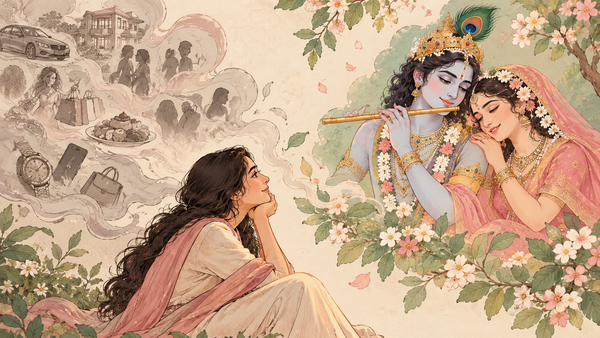
- You must be a devotee of samarthā rati, i.e., one who thinks and works only for the pleasure of Shyamsundar, with zero desire for one's own enjoyment. This was the love of the Gopis, also called nishkaam prem, or selfless love.
The Gopis held on to their bodies. Not a single gopī died, despite enduring the pain of separation from Shri Krishna for a hundred years, because they thought, "I have already given my body to Him. If He comes today, He will ask, 'Where is she?' So I must not leave this body. I must serve Him with this body, but not for my happiness. Whether He comes in fifty years, a hundred years, or even after a hundred yugas, I have no objection." They accepted any manner in which Shri Krishna chose to behave with them, without even a hint of "but," "if," or "however." This is the selfless love between the Guru and his disciple, and between God and His devotee. Such love cannot exist in this world, where both parties seek their own happiness.
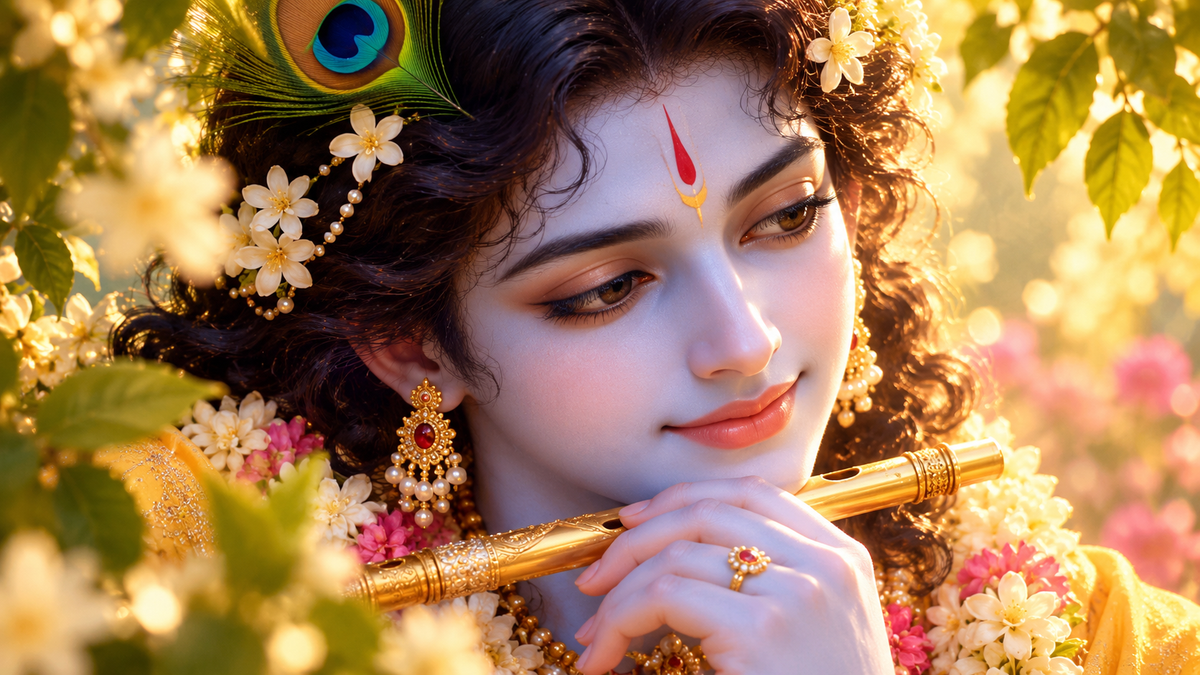
So the sweetest nectar is that of Shri Krishna in Kunj. He is our Shyam. Understanding this, you should love Him selflessly, for His happiness alone.
Recommended books by Jagadguru Shri Kripalu Ji Maharaj related to this topic: