The Only Difference Between Attachment and Divine Love
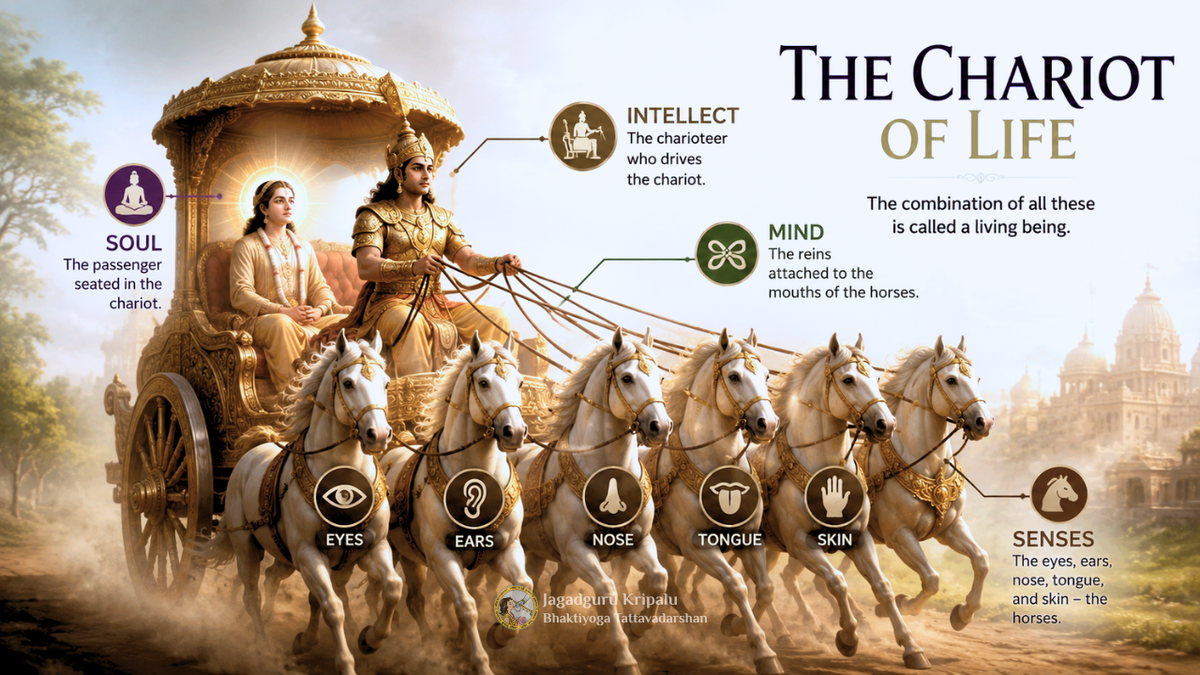
Our body is like a chariot. Within this body are the following:
- The eyes, ears, nose, tongue, and skin - the senses - are the horses.
- Inside the body is the mind, which is like the reins attached to the mouths of the horses.
- The intellect is the charioteer who drives the chariot.
- The passenger seated in the chariot is called the soul.
The combination of all these is called a living being.
Brahm has three forms -
- Bhoktā Brahm - the individual soul (jīva), the one who experiences.
- Bhogya Brahm - the world, the object of experience.
- Prerak Brahm - God, who provides the inspiration.
Thus, within your body are:
- Ten senses
- One mind
- One intellect, and
- One soul.
Collectively, these are referred to as the senses, mind, and intellect. More briefly, they are called the mind and intellect, and in the briefest sense, simply the mind.
The same set of senses, mind, and intellect exists in souls bound by māyā, in God-realized saints who have transcended māyā, and even in God Himself. God possesses no different kind of senses, mind, or intellect. He too has these very faculties.
Among all these, who is the doer - the one who performs actions? It is the intellect. It is the driver, the governor. Whatever the condition of a person's intellect, accordingly it directs the mind; the mind then directs the senses; the senses act accordingly; and the traveler - the soul - moves in that very direction.
There are only two possible directions: one towards the East, the realm of God, and the other towards the West, the realm of māyā.
The realm of māyā consists of two kinds of objects:
- Inert objects - food, drink, wealth, possessions, and all other material objects.
- Conscious beings - mother, father, son, husband, and all other living beings who are themselves under the influence of māyā.
Wherever the mind becomes attached within either of these two categories - regardless of the sentiment behind that attachment - it is called attachment (āsakti).
The result is wandering through the cycle of 8.4 million life forms, accompanied by sorrow, restlessness, dissatisfaction, incompleteness, and bondage to karma. It is like poison. Therefore, it has been condemned in the scriptures and is called 'preya' - that which appears pleasant but ultimately leads to suffering.
The second realm is the divine realm - the realm of God and the saints who have attained Him. God, His names, forms, pastimes, qualities, abodes, and His saints all belong to this realm.
When the mind becomes attached to any of these, it is called love (prem).
This love is nectar. Through it one attains immortality, eternal divine bliss, and eternal divine knowledge. This is called 'shreya' - that which leads to one's highest welfare.
The only difference between attachment and love is that they are completely opposite to one another because their results are completely opposite.
Gaurāng Mahāprabhu said:
kāma aṃdhatama, prema nirmala bhāskara
Love is like the radiant sun, whereas attachment is like the deepest darkness.
People in the world say to one another, "I love you." Yet they do not even know the true definition of love. Love is the very form of God. What they experience is not love at all; it is merely attachment directed towards the wrong object.
The human birth is exceedingly rare, even for the celestial beings.
Think about it. Even when your meals are prepared and waiting for you at home, you still experience so much suffering. Then what must be the condition of a dog, a cat, or a donkey? Animals spend their entire day wandering merely to fill their stomachs. They have no permanent home, no protection from heat, cold, or rain, and no assurance of finding food even for the present day, let alone tomorrow.
In spite of all this suffering, human beings capture them and exploit them for their own comfort. To fulfill their selfish purposes, people enslave horses, bulls, cows, buffaloes, and many other animals and beat them with sticks.
We ourselves have taken birth in these species countless times. If we do not practice devotion in this rare human birth, we shall once again have to enter those very life forms. Reflect upon how great that suffering will be.
There is no difference in the method of loving God.
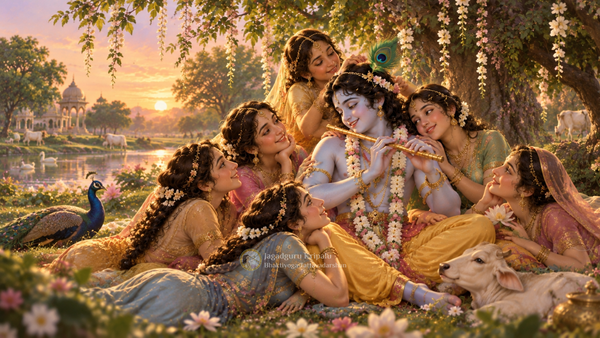
Just as Lailā loved Majnū, Meerā loved Shri Krishna, and the Gopīs loved Shri Krishna, so, too, can one love God. They possessed the very same senses that we possess.
Consider three people. One drinks milk from a cup, another drinks alcohol from a cup, and the third drinks poison from a cup. The act of drinking is exactly the same. Yet the one who drank milk gained strength; the one who drank alcohol lost his power of reasoning; and the one who drank poison destroyed his body.
Similarly, if we offer our body, mind, and soul to the material world, we shall receive only worldly results. But if we offer them to God and His saints, we shall transcend māyā and attain eternal divine bliss and divine knowledge.
The nature of surrender is the same. The difference in the result lies only in the object of our love. Whatever qualities and powers the one we love possesses, those are the qualities and powers we receive. It is as simple as that.
Suppose a girl marries a young man. Later, he wins a fortune in the lottery and becomes a millionaire. She then becomes the wife of a millionaire. Another girl marries a man who was equally educated, but he becomes an alcoholic and ends up a beggar. She too becomes the wife of a beggar and shares his condition.
In the same way, we are bound to love someone. If not today, then tomorrow. No one can escape this. Whatever or whoever we truly love, that is what we attain after death.
The Brahmgyāni, Jad Bharat, became attached to a young deer out of affection. He raised it, nourished it, kept it beside him, fed it with his own hands, carried it in his lap, embraced it, and showered it with affection. As a result, he had to be born as a deer after death.
Therefore:
śreyaḥ ādadānasya sādhu bhavati
He who embraces shreya, that is, who directs his love towards the divine realm of God, attains the supreme good. The fruit of such love is eternal divine bliss. Therefore, it is called prem.
Love is transcendental, indescribable, and divine.
Attachment, on the other hand, is condemnable. It is worldly, material, physical, sensory - it has many such names.
Always remember this one truth: there is no difference in the act of loving and the act of becoming attached. The only difference lies in the object.
If the object of our love belongs to the right realm - that is, the realm of God - it is called prem. If it belongs to the wrong realm - the realm of māyā - it is called āsakti.
There is no third realm.
Your mind is attached somewhere within one of these two realms, whether or not you are able to recognize it. Your knowledge is limited.
A wife quarrels with her husband, or a son quarrels with his father. In anger, one may say, "I have no relationship with you anymore." Yet if that very husband, wife, or son dies, the same person weeps bitterly. Why? Because the attachment already existed; the death merely brought it to the surface. A husband and wife may quarrel throughout the day, yet when one of them dies, the other experiences deep grief. If there had been no quarrels at all, the grief would have been even greater.
The greater the attachment, the greater the pleasure one derives from its object. And when that object is taken away, the greater the suffering one experiences. This is the philosophy.
Recommended Reads: