The Great Paradox of the Spiritual Life: Sādhanā or God's Grace?
From the Vedas to the Ramayana, every scripture contains two seemingly opposite statements:
- Without sādhanā (devotional practice), the sādhya - the goal (God or divine bliss) - cannot be attained.
Gaurang Mahaprabhu also said:
"Sādhan binā sādhya kabhu nāhi milay."
Without devotional practice, the goal can never be attained.
Just as every worldly object is obtained only through effort, one must also practice and strive on the spiritual path.
For example, merely placing a delicious meal before you will not satisfy your hunger. First, the intellect instructs the mind. Then the mind directs the senses: "O hand, pick up the rasgulla and place it in the mouth. O teeth, chew it. Now swallow it. Still hungry? Eat another. Now my stomach is full - stop."
Even before that, effort was required to obtain the rasgulla. You had to go to the market, purchase it, and bring it home. To buy it, you first needed money. To earn money, you had to work. To get the job, you had to study for many years. Only after this entire chain of effort does the stomach finally become full.
Even breathing is an action. We hardly notice it because it has become habitual, but if you hold your breath, discomfort immediately arises. Blinking is also an action. With sufficient practice, an action becomes so natural that it appears to happen by itself.
Thus, just as effort is indispensable for achieving any worldly goal, sādhanā is indispensable on the spiritual path as well.
- On the other hand, the scriptures also say that sādhanā alone can accomplish nothing. Without God's grace, one cannot attain God or divine bliss.
Those who study the scriptures relying solely on their own intellect often remain confused throughout their lives, wondering which of these statements is true.
Yet both the words of God-realized saints and the statements of the beginningless Vedas are eternally true. Neither can be false.
So both statements are true. But how?
The answer is as follows.
Through sādhanā, one can attain heaven, mystical powers, and every other achievement that lies within the realm of māyā.
Why?
Because the means available to us - the senses, the mind, and the intellect - are themselves material. Material means can obtain only material objects. Using these material means, one cannot attain the divine goal of liberation from māyā or divine bliss.
Regarding these, a different law applies:
nitya-siddha kṛṣṇa-prema sādhya kabhu naya.
Love for God, or liberation itself, is never something that can be attained solely through sādhanā.
Why is this so?
Even in the material world, every instrument has its own function. If your hearing is weak, you wear a hearing aid. That same device cannot help your eyes. If your eyesight is poor, you wear glasses - not a hearing aid. No matter how brilliant a scientist may be, one sense cannot perform the function of another.
Then how could something divine possibly be attained through material means? The question itself does not arise.
Liberation from māyā and the attainment of God are divine goals. Therefore they cannot be achieved through sādhanā alone. They are attained only through God's grace.
A naive person may then ask, "If everything depends on God's grace, why perform sādhanā at all?"
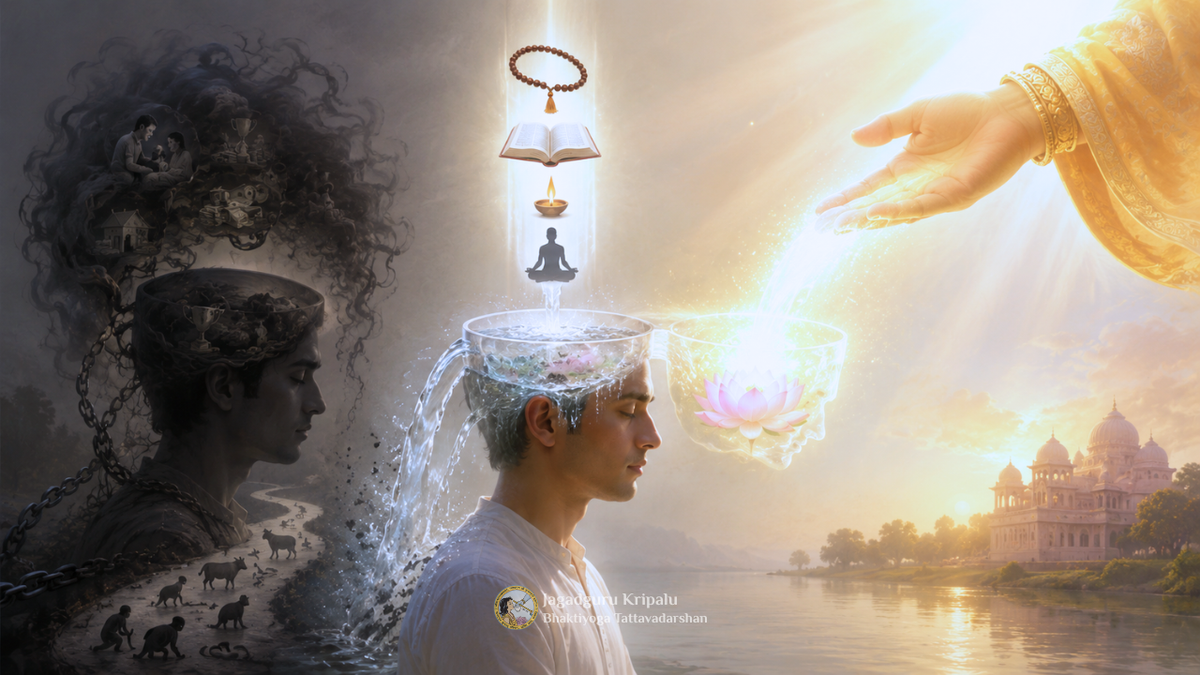
From the Vedas to the Ramayan, all the scriptures prescribe sādhanā because it prepares the vessel.
The divine gift bestowed through God's grace can only be received in a vessel that has itself become fit to receive it.
That vessel is the mind.
At present, our mind is impure and material. It must first be cleansed and made worthy. This purification of the mind is called sādhanā-bhakti.
Through sādhanā-bhakti, the heart becomes purified.
External organs - the eyes, ears, and body - can be cleaned with water and soap. But the mind carries the accumulated impurities of countless lifetimes. Those impurities bind the soul and keep it wandering through the cycle of eighty-four lakh species.
Therefore, it is the mind that must be purified.
This purification comes through sādhanā bhakti. That is why sādhanā is indispensable.
Yet even after the mind has become pure, liberation and divine bliss still cannot be attained by one's own effort. For that, God's grace is essential.
Through His grace, God transforms the purified mind into a divine mind.
Therefore, your duty is to purify the mind.
What does purifying the mind mean?
It means removing all worldly impurities - attachment to parents, children, spouse, wealth, prestige, and every other worldly possession - and emptying the mind of both attachment and hatred.
This purification takes place through sādhanā-bhakti.
Once the mind has become pure, God, through His grace, makes it divine. Then the Guru bestows divine love and liberation from māyā without taking anything in return.
In other words, through your own effort you purify the mind. The moment that purification is complete, God removes māyā and resides within that purified mind. Thereafter, the soul can never again sin.
Thus both sādhanā and God's grace are indispensable. Understanding this resolves all apparent contradictions.
Read: