Sādhanā Rules


Sādhanā Rules -
There are rules governing everything throughout the universe. There are rules in God's realm, just as there are rules in the realm of Maya. Nothing exists without rules. Even the tiniest particle follows certain laws. Whatever you do in this world, there are rules governing it. If you don't follow these rules, the activity may not benefit you and may even cause harm. Therefore, you must follow rules during sādhanā as well.
Just as your being has two aspects, your gross physical body and the subtle inner mind, there are two kinds of rules: external and internal.
The First External Rule: No Talking -
The first and most essential external rule is that you must not engage in any conversation. This is because, during sādhanā, you can unknowingly fall into bad association (kusang) through conversation. Everyone sitting here is guilty of this, as are those who have not come. You forget how dangerous kusang can be and become overconfident, thinking that it will not affect you. But it can. The influence of kusang can harm you right up to a second before you attain God.
Ajāmil became an example of how far a person can fall. According to the Bhagavatam, his life before his downfall was so exemplary that no one could have imagined he would fall so low. The Bhagavatam describes him as self-controlled, virtuous, learned in the scriptures and Vedas, well-versed in spiritual knowledge, and humble. He possessed all the divine qualities one could wish for. Yet a single moment of kusang brought about his downfall, making him an example among sinners.
Then, what standing do you have? On what grounds do you assume that kusang will not affect you? You forget how vulnerable you are. When someone starts talking about worldly matters or criticizing another person, you begin listening. The very fact that you listen shows how contaminated and impure your mind still is. It shows that you are not yet sincerely intent on attaining God.
When you are eating, and a tiny stone gets caught between your teeth, you immediately stop chewing, remove it, and throw it away. But when you practise sādhanā under the guidance of your Guru for the welfare of your soul, you forget to exercise the same care and keep swallowing these spiritual 'stones'! What good can they do once they enter your system?
You listen to others criticize someone and then give their words such importance that you may even trust them more than your Guru's words. You believe what they say, even though you know that they, like you, have limited knowledge. Unless someone is omniscient, they cannot know another person's true inner state with certainty. Only God and God-realized saints can accurately understand a person's inner state. Anyone who claims to possess such insight without being omniscient is gravely mistaken - there is no one more foolish than them, and their downfall is certain, if not today, then tomorrow.
Gaurang Mahaprabhu said:
hena kṛṣṇa nāma laye bahu bāra,
tabe prema nahīṃ, nahe aśrudhāra,
tabe jāni aparādha āchaye pracura.
If someone has chanted God's Name again and again, yet divine love does not awaken within them, and tears of love do not flow, there is only one reason: nāmāparādh.
nāmnām akāri bahudhā nija-sarva-śaktis tatrārpitā niyamitaḥ smaraṇe na kālaḥ
etādṛśī tava kṛpā bhagavan mamāpi durdaivam īdṛśam ihājani nānurāgaḥ (Shikshashtak)
God has invested all His powers in His Divine Names and has placed no restrictions on when they may be remembered or chanted. Such is His boundless grace. Yet, despite chanting and hearing God's divine names, if the seed of divine love does not sprout in your heart, it is because of nāmāparādh.
Therefore, rules governing the mind are essential, and external rules are equally necessary.
If we stop speaking, we will also stop listening. After all, only a few sādhaks are here. If no one speaks, what will anyone else listen to? Speaking and listening are the two dangers we must guard against.
Therefore, the first rule is this: no one here is to engage in conversation with anyone else, even if a husband and wife have come together. Make a firm resolve to observe this rule.
What is so difficult about remaining silent for ten or fifteen days? Speaking requires the intellect to work. You must first think and then formulate your sentences. Your senses, mind, and intellect all become engaged, and the process requires effort. But what intellectual effort does it take to remain silent? None at all! Whether someone is a great scholar like Bṛhaspati or completely uneducated, both can sit silently beside each other.
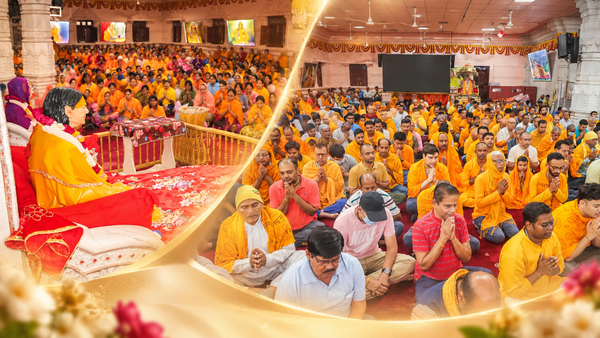
Therefore, take this as my request or my command, whichever you prefer: for as long as you remain here for sādhanā, do not engage in conversation. Be present punctually for every activity scheduled here, and follow the rules prescribed for each activity precisely.
Recommended books by Jagadguru Shri Kripalu Ji Maharaj related to this topic: