Detachment and Attachment
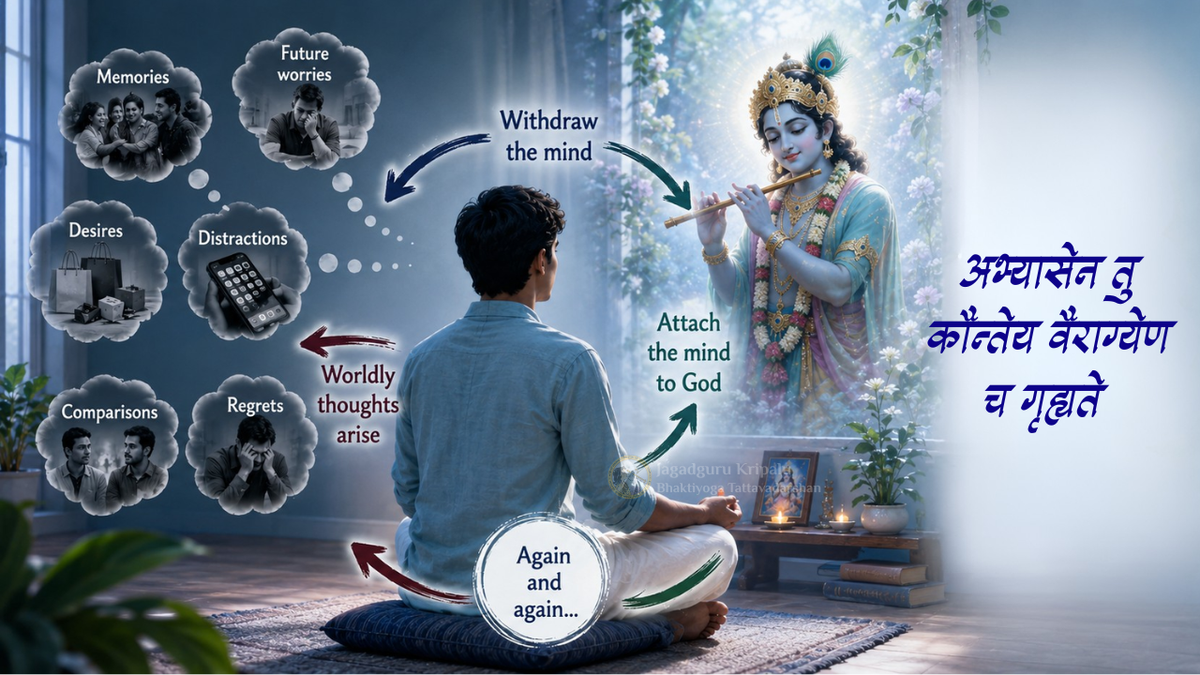
The scriptures and Vedas contain two seemingly contradictory statements. One says that detachment from the world must come first, while another says that attachment to God must come first.
While explaining this, Shri Maharaj Ji emphasised the most important point: both detachment (vairāgya) and attachment (anurāg) exist only in the mind. The scriptures, the Vedas, and God do not regard any other kind of detachment or attachment (that is, of the body) as genuine, nor does it bear any spiritual fruit.
bahu janma kare yadi śravaṇa kīrtana, tabhū na pāya kṛṣṇa pade prema dhana -
You may practice the nine forms of devotion (navadhā bhakti) for countless lifetimes, but if you do not attach your mind to God, it is all futile. "Futile" does not mean that it is entirely bad. If someone constantly chants God's name, they will occasionally develop feelings of devotion toward Him. They will still reach the goal, but it will take much longer. Ultimately, however, the mind must become attached to God.
Just as a child is first taught to write by having the teacher hold their hand, similarly, the saints have said -
bhāva kubhāva anakha ālasa hūm
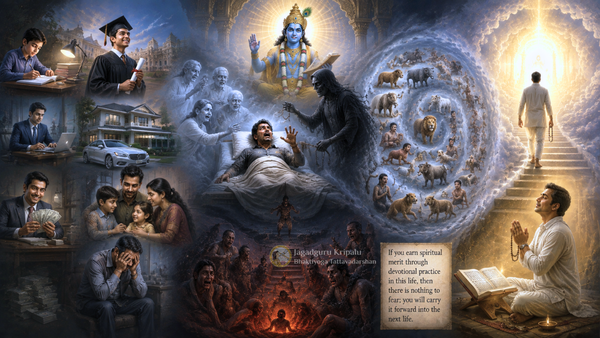
No matter how God's name is chanted, it is still God's name. But this is a long path. Our human life is short, and the condition is that we must attain our spiritual goal in this very human birth. It cannot be accomplished in any other form of life.
Therefore, the solution is that both statements from the scriptures are correct: indeed, detachment comes first, and it is equally true that attachment comes first.
The scriptures and Vedas are divine revelation; they cannot be wrong. Just as the Vedas are eternal, beginningless, and not composed by any human being, so too is the Ramayana divine. This is because every action of a God-realized Saint is truly God's action. The moment a Saint attains God-realization, all personal doership comes to an end. After that, they no longer act independently.
In the Bhāgavatam, when Shukdev narrated the episode of the Rās Leela, King Parikshit was startled. He asked why God performed the Rās with the wives of other men. He asked Shukadev -
saṁsthāpanāya dharmasya praśamāyetarasya ca। avatīrṇo hi bhagavānaṁśena jagadīśvara:॥
sa kathaṁ dharmasetūnāṁ vaktā kartābhirakṣitā। pratīpamācarad brahman paradārābhimarśanam॥
"God Himself has declared in the Gita that He incarnates to establish righteousness. Then why did He perform the Rās?"
Shukadev smiled and replied, "You are a king, so even at the time of death, your intellect still thinks like a king."
He explained that God and the great Saints are all-powerful. At times, they may perform actions that appear contrary to ordinary standards of righteousness, but profound reasons lie behind them. None of their actions is ever purposeless. There are many subtle aspects beyond our understanding. For example -
- Their actions are always intended for the welfare of others.
- Their actions have connections to previous lives. Our intellect cannot comprehend such matters. Therefore, do not apply your ordinary reasoning there.
Īśvarāṇāṁ vachaḥ satyaṁ - simply follow the instructions of a genuine saint.
'tathaivācaritaṃ kvacit' - You must follow only those aspects of their conduct that are appropriate for your own spiritual level.
A student cannot teach simply by sitting in the teacher's chair. They must first complete their own education. If someone tries to teach without the necessary qualifications, they will be unable to answer students' questions because they lack the necessary knowledge.
So, both scriptural statements are correct.
Likewise, never say that detachment and attachment will simply "happen." Do not use the word "happen." People often go to a Saint and say, "My mind does not become attached to God; it remains attached to the world."
What does it mean for the mind to become attached? It means that it goes somewhere naturally, on its own. The mind naturally goes toward the world. Why? Because for countless lifetimes -
- You have regarded the world as the source of happiness.
- You have deliberately attached your mind to worldly pleasures.
These impressions have developed very deep roots. Others told you that happiness lies in the world, and you believed them. So you attached your mind there.
With every habit, you first practice, and only later does it become natural. Practice comes first; naturalness comes afterwards. That is what we call a habit. Since the mind has been attached to the world since beginningless time, it naturally runs toward it.
Therefore -
- Your first task is to withdraw the mind from the world. Do not say, "It doesn't withdraw." Withdraw it forcefully. How? First, understand the philosophy. There is no real happiness in this world. The world has been created for the body, whereas I am the divine soul. My true bliss is divine, and it is found only in God. With this philosophical understanding, withdraw the mind from the world. When the mind is withdrawn through true knowledge, it gradually becomes detached from worldly objects.
- However, do not leave the mind empty even for a single second after withdrawing it from the world. Immediately attach it to God. Both tasks must be done together. Remember, this will not happen automatically.
There has never been, nor will there ever be, a Saint who can simply give you a magical potion that will automatically make your mind become attached to God. God has descended infinite times, and He already resides within every heart, yet He does not do this for us. This is something each person must do themselves.
Therefore, practice is essential: withdrawing the mind from the world (vairāgya) and attaching it to God (anurāg). Both practices are our responsibility.
'abhyāsena tu kaunteya vairāgyeṇa ca gṛhyate' - both are necessary.
As you repeatedly withdraw the mind from the world and attach it to God, the process gradually begins to take effect. While meditating on God, worldly thoughts will arise because of long-standing habits. Do not become discouraged. Simply withdraw the mind again and attach it once more.
Just as we fell thousands of times before we first learned to stand, similarly, the mind will gradually begin to attach itself to God. Now comes the stage of "happening naturally." Even then, the mind will again wander away. Up to the 50% mark, you will have to exert much greater effort. But once you cross the 50% mark, the mind begins to rest in God much more easily.
Then, if someone simply says 'Radhey,' we immediately take notice. You think, "This must be a good person. Perhaps this person is one of Maharaj Ji's devotees," even though they may simply have uttered 'Radhey', while thinking of someone else. This transformation happens only through God's immense grace; it is not our own achievement. God brought us to Shri Maharaj Ji, who repeatedly filled our intellect with spiritual knowledge. We cannot truly understand after hearing something just once. At the time, we may say, "Everything is perfectly clear. Maharaj Ji explains so wonderfully." Yet afterward, we forget.
The more the mind becomes attached to God, the more it automatically withdraws from the world. After crossing 50%, the mind naturally begins to lose interest in worldly things. If people start talking about worldly matters, they begin to feel unpleasant. One thinks, "The world is always full of unnecessary complications. Let me turn toward God instead."
By continuing this practice, one eventually reaches the state of 'mamekam sharanam vraja' - complete surrender. When the mind becomes one hundred per cent attached to God, one hundred per cent detachment from the world comes automatically. These are known as natural attachment (sahaj anurāg) and natural detachment (sahaj vairāgya).
sahaj virāga rūpa mana mora -
Here "natural" means that no effort is required any longer - it happens of its own accord. This is the perfected state.
The perfected state is not attained in the beginning. First, we ourselves must engage in devotional practice. It is a very long journey.
Read: