What Lies Beyond Heaven, Brahmānand & Vaikunth?
What is Braj Ras?
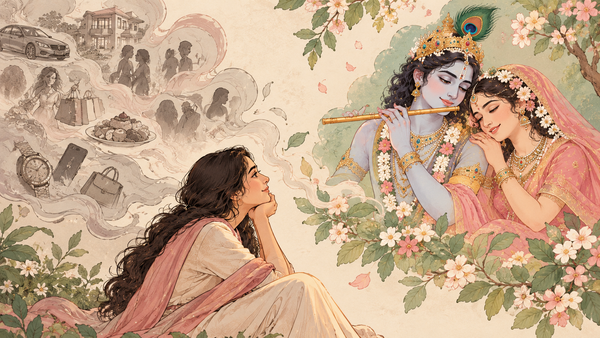
The word ras literally means "taste" or "essence." In this context, it refers to the kind of pleasure or enjoyment one experiences. There are many levels of ras, beginning with the pleasures of the material world and progressing toward ever-higher forms of divine pleasures.
We experience three broad kinds of ras in the material world every day:
- Tāmasic ras - Those dominated by tamas, the quality of ignorance and darkness, who indulge in activities such as alcohol and meat-eating, attain hell.
- Rājasic ras - Those dominated by rajas, the quality of passion and material desire, remain bound within the earthly realm.
- Sāttvic ras - Those dominated by sattva, the quality of goodness and purity, attain heaven - but only for a limited period.
However, all three are false rasas. They have two fundamental limitations.
i) All three are limited.
There is always a higher ras beyond them.
When we encounter a ras greater than the one we currently experience, the pleasure we once found fulfilling begins to feel bland. The very thing we once desperately desired gradually loses its appeal after we attain it, and our longing for something greater begins to cause dissatisfaction and suffering. This is the fundamental problem with the entire material creation. It affects not only human beings but even the celestial gods.
ii) All three are perishable.
In every material object or relationship, there is initially some pleasure. Then there is less pleasure, then still less, and eventually that very thing begins to cause pain. This is the perishable nature of material ras.
Therefore, these are not true rasas at all. They are material or illusory rasas. It is through these very forms of enjoyment that we have been deceived and have wandered endlessly through among the various life forms since beginningless time.
sūkha hāḍa lai bhāga saṭha svāna nirakha mṛgarāja -
Just as a dog chews on a dry bone, its own mouth and throat begin to bleed. The dog then licks the blood from the bone and imagines that the blood - and therefore the pleasure - is coming from the bone itself.
In the same way, we experience pleasure in this world and imagine that the pleasure comes from the objects, people, or experiences themselves. In reality, the pleasure is merely a projection of our own mind.
Everyone has different tastes and preferences. If genuine pleasure existed inherently within a material object, then everyone should experience the same pleasure from that object. For example, a person who is addicted to alcohol may become excited merely upon hearing the word "liquor." But a learned Brahmin scholar feels an aversion upon merely hearing the same word. If the pleasure were actually inherent in the liquor itself, both should experience the same pleasure from it.
Therefore, this material ras is not true ras at all. It is like poison. There are two kinds of poison: one is bitter, while the other is mixed with sugar. The material world is like poison mixed with sugar. It contains enough sweetness to keep us attached, but ultimately it brings suffering.
Beyond these three material forms of ras lies a fourth ras.
- Brahmānand
This is the infinite and eternal bliss of the formless, attributeless, impersonal Brahm.
This is the infinite and eternal bliss of the formless, attributeless, impersonal Brahm.
It is comparable to the happiness experienced in deep sleep. As long as one remains in deep sleep, there is neither an increase nor a decrease in the experience of happiness. Similarly, Brahmānand is attained as an infinite and unchanging state of bliss.
Nevertheless, this is by no means insignificant. The state of Brahmānanda cannot be attained even after striving through millions of births.
Yet there are still higher forms of ras.
- The ras of Vaikunth
In Vaikunth, ras continually increases. Yet even here there is a limitation: the ras is mixed with aiśvarya, or divine majesty and opulence.
It is mādhurya - sweetness and intimacy - mixed with aiśvarya, God's divine majesty.
Beyond this lies -
- The ras of Shri Krishna in Dwarika.
Here, aiśvarya is less prominent than in Vaikunth, while mādhurya is greater. This ras also increases at every moment. Yet there is an even more delightful ras beyond this.
- The ras of Mathura.
Here, mādhurya is still greater, and aiśvarya is extremely little.
Beyond this lies -
- Here, there is no aiśvarya whatsoever. There is only mādhurya ras - pure sweetness, closeness, and love - and this ras increases eternally, at every moment.
This ras is of four kinds:
i) Dāsya bhāv - the sentiment of servitude toward the Lord.
ii) Sakhya bhāv - the sentiment of friendship toward the Lord.
iii) Vātsalya bhāv - the sentiment of parental love toward the Lord.
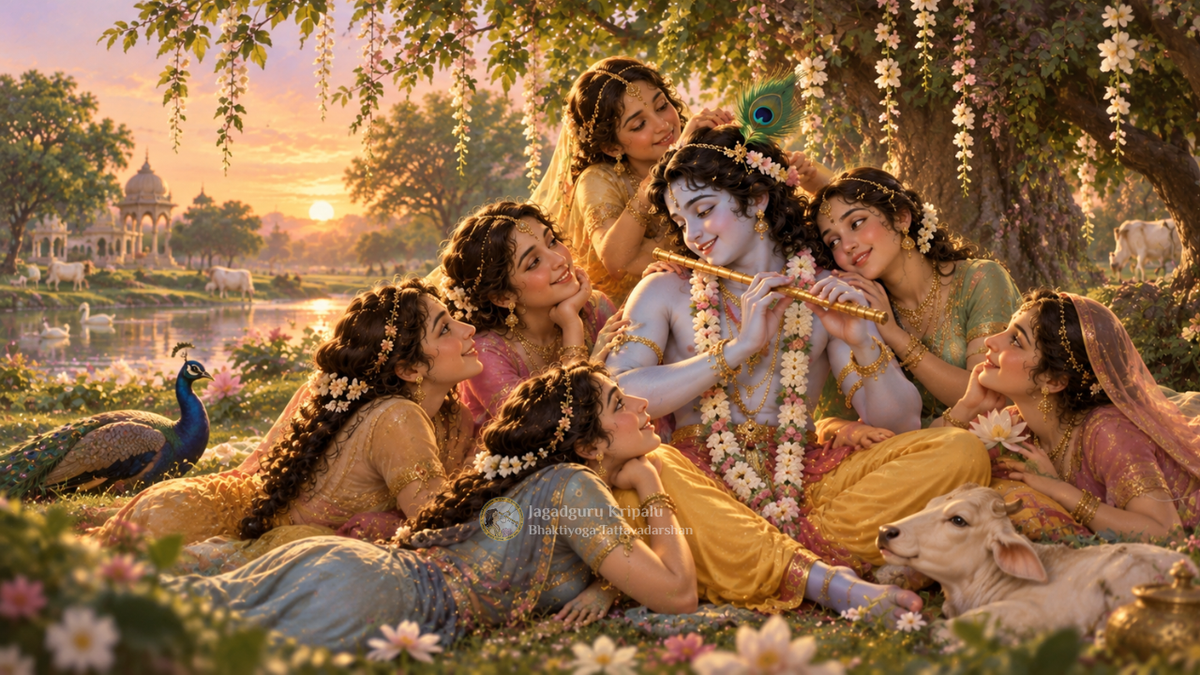
iv) Mādhurya bhāv - the sentiment of the beloved.
Among these four, sakhya ras is more delightful than dāsya ras. A servant cannot make God into his horse. But Krishna's friends not only make Him their horse - they may even kick Him in the belly while commanding Him, "Run faster!" And Thakur Ji becomes overwhelmed with joy. Yet even within sakhya bhāv, a certain degree of reservation remains.
More intimate and delightful still is vātsalya ras. Just as a parent has complete authority over a small child, Nand and Yashoda possessed such loving authority over Thakur Ji. Their relationship with Him was so intimate that Thakur Ji would place Nand Ji's wooden sandals upon His own head and carry them before him.
Greater still is mādhurya ras, the loving relationship between the God and His beloved. Even within mādhurya bhāv there are three states:
- Sādhāraṇī rati - Here, there remains some desire for one's own happiness, as in the case of Kubja and others.
- Samanjasā rati - Here, one desires the happiness of both oneself and the beloved, as in the case of Rukmini and others.
- Samarthā rati - Here, one desires only the happiness of Shyamsundar. Not "His happiness as well as my own."
Not even "His happiness along with mine."
There is only one desire: that Shyamsundar be happy.
This mādhurya bhāv of samarthā rati belongs to the gopīs.
This alone is Braj ras.
Beyond Braj ras, there is no higher ras that any soul can attain. The ras beyond this - the mādanākhya ras bhāv - is Radharani's unique position. No other soul can attain it. In fact, no soul can even attain the position of Lalita or Vishakha.
Below that lies the kunj ras, which is within the domain of Braj ras. A soul may attain up to this level.
But the most essential point of all is this:
There must be absolutely no desire for one's own happiness. There must be only one desire: the happiness of Shyamsundar.
This complete absence of self-interest and the exclusive desire for the happiness of the Beloved is the essence of Braj ras.
Recommended books by Jagadguru Shri Kripalu Ji Maharaj related to this topic: