The Three Bodies Within You
Explanation of Some Technical Terms from the Scriptures -
Three types of bodies:
- Gross body (Sthūl sharīr)
- Subtle body (Sūkṣma sharīr)
- Causal body (Kāraṇ sharīr)
Sthūl sharīr - Gross Body -
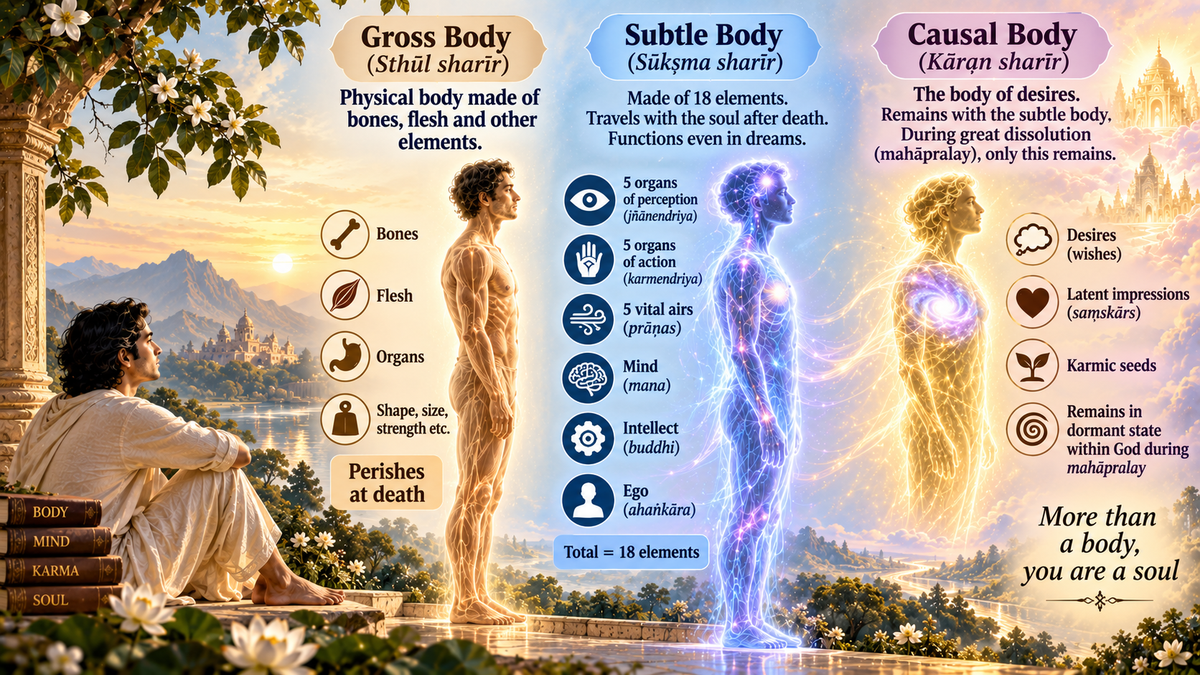
The sthūl sharīr is the physical body - the body that may be strong, bulky, fat, tall, or broad. It is made of bones, flesh, and other physical elements. When this physical body dies, the subtle body leaves it along with the individual soul.
Sūkṣma sharīr - Subtle Body -
The sūkṣma sharīr is made up of eighteen elements:
- Five jñānendriya- the organs of perception - eyes (sight), ears (hearing), nose (smell), tongue (taste), and skin (touch) - total 5)
- Five karmendriya - the organs of action, such as the hands, legs, and others (total 5)
- Five prāṇas - vital airs - prāṇa, apāna, vyāna, samāna, udāna (total 5)
- One mana - the mind (1)
- One buddhi - the intellect (1)
- One ahaṅkāra - the ego (1)
Thus, the subtle body has eighteen elements.
When the soul leaves the gross body, it takes these eighteen elements with it. The soul does not first leave the body and then take these elements separately. Rather, the soul leaves the gross body while carrying the subtle body with it. This departure is what people call death.
For example, a snake sheds its outer skin, which is called kenchul. The snake sheds the old skin only after a new skin has already formed underneath it. If the old skin were removed before the new one had formed, the snake's body would be wounded. Similarly, when a boil forms on our skin, the outer skin sheds only after new skin has formed underneath it. In the same way, the soul leaves the gross body while carrying the subtle body, which consists of these eighteen elements.
Sa yadi asmāt śarīrāt utkrāmati sahai vaitai: sarvai: utkrāmati
Gṛhītvaitāni saṅyāti (Gita)
During a dream, all eighteen elements continue to function. In a dream, you see, hear, smell, eat and drink, touch, walk, run, and grasp objects, just as you do with your gross body while awake. While dreaming, you do not realize that you are dreaming. You experience the events as though they are actually happening. Only after you wake up do you think, "Oh, that was just a dream."
Kāraṇ sharīr - Causal body -
The kāraṇ sharīr, or causal body, is the body of desires. In other words, your wishes and desires themselves constitute the kāraṇ sharīr. The kāraṇ sharīr remains with the sūkṣma sharīr. However, during mahāpralay, the great dissolution, even the sūkṣma sharīr does not remain. At that time, only the kāraṇ sharīr remains.
The body of desires then remains in a dormant state within God. At that time, the mind and the other faculties do not exist.
Five sheaths - Pañcakosh:
There are five sheaths:
- Annamaya kosh -
Your gross physical body, through which you move and perform actions, is called the annamaya kosh, or sheath of food. - Prāṇamaya kosh -
The five organs of action and the five vital airs (vāyus) together form the prāṇamaya kosh, or sheath of vital energy. - Manomaya kosh -
The five sense organs - eyes, ears, nose, tongue, and skin - together with the mind form the manomaya kosh, or sheath of the mind. - Vijñānamaya kosh -
The five sense organs together with the intellect form the vijñānamaya kosh, or sheath of knowledge. - Ānandamaya kosh -
The causal body associated with desires is called the ānandamaya kosh, or sheath made of bliss.
When these five sheaths and three bodies are destroyed, one attains liberation.
Five afflictions - Panchaklesh:
- Avidyā - ignorance
- Asmitā - ego (ahaṅkār)
- Rāg - attachment
- Dvesh - enmity
- Abhinivesh - fear of death
These five are called pañchaklesh.
When a person becomes free from all five afflictions, the soul becomes liberated.
Three kinds of suffering - Tāp:
- Ādhyātmik - suffering arising from one's own body and mind
- Ādhidaivik - suffering caused by natural, cosmic, or divine forces
- Ādhibhautik - suffering caused by other living beings
Ādhyātmik Tāp is of two types:
- Physical suffering (shārīrik tāp) - diseases and physical ailments of the body, such as diarrhea, fever, cancer, etc.
- Mental suffering (mānasik tāp) - mental afflictions such as lust, anger, greed, delusion, jealousy, and hatred.
Ādhidaivik tāpa -
This refers to suffering caused by cold, heat, and other extreme weather conditions and natural disasters. For example, some people die from heatstroke, while others suffer or die because of extreme cold.
Ādhibhautik tāpa -
This refers to suffering caused by other living beings, such as people or animals. For example, a wicked person causes pain and suffering to others without any reason.
Three types of karma:
There are three types of karma -
- Sanchit - accumulated karma
- Prārabdh - karma that has begun to bear fruit
- Kriyamāṇ - karma being done in the present
Sanchit karma -
Sanchit karma is infinite. It is the storehouse of actions accumulated over innumerable past births. It contains both infinite sins and infinite virtues because the number of births itself is infinite. The soul has no beginning; you are beginningless.
Prārabdh karma -
From the accumulated store of sanchit karma, God designates a small portion for the present birth. This portion is called prārabdh karma. God resides within you and makes you experience the fruits of this karma. Otherwise, why would anyone willingly choose to experience suffering? If it were entirely within your control, you would simply destroy the record of your bad karma. Therefore, God dwells within you and makes you experience the results of both good and bad actions.
If you say, "It is terrible that God makes us experience the fruits of bad karma," then understand this: if He did not give the fruits of bad karma, He would also not give the fruits of good karma. Then what would you do? How would you attain God? Therefore, He gives the fruits of both good and bad karma.
By giving the fruits of bad karma, He brings you to your senses and reminds you, "Hey, do not remain intoxicated." The mother you love, the father you love, and the son you love - all of them are selfish. Everyone is selfish. When you leave this world, they will all remain here and bid you farewell. Even if someone drinks poison in an attempt to accompany you, that person cannot go with you. Each soul departs separately according to its own karma.
Some people may stubbornly think: "If my son dies, I will also die," or "If my husband dies, I will also die by drinking poison." Such a person may also die, but after death, they become a ghost; they do not go with the person who died. No one goes together - not the mother, father, son, or daughter. Every soul departs separately according to its own karma.
Everyone must experience their prārabdh karma, whether they are a God-realized saint or a soul bound by māyā. The difference is that a saint does not experience these circumstances as suffering, whereas a soul bound by māyā does. The fathers, sons, and others of both will die in due course. According to their prārabdh karma, a worldly person experiences poverty, suffering, dishonor, and other difficulties. A saint, however, does not perceive these circumstances as suffering or experience the pain. This is the difference.
Kriyamāṇ karma -
The actions we perform in the present create sanchit karma, and from the accumulated sanchit karma, prārabdh arises. The actions you perform in this birth are called kriyamāṇ karma. You have the freedom to perform either good or bad actions. Prārabdh does not mean that every action you perform is predetermined. Prārabdh is limited in its scope and manifests only at certain times. Apart from that, you retain the freedom to act.
Recommended books by Jagadguru Shri Kripalu Ji Maharaj related to this topic: