You Will Have To Go Alone
We all came into this world alone, but people forget that we will have to leave alone as well. We have developed deep relationships and attachments with our mother, father, son, and others, but when the time comes to depart, no one can do anything about it. Great scientists, doctors, yogis, sages, munis, and ascetics have all come into this world and departed, and more will continue to do so. Yet none of them could do anything to change this law.
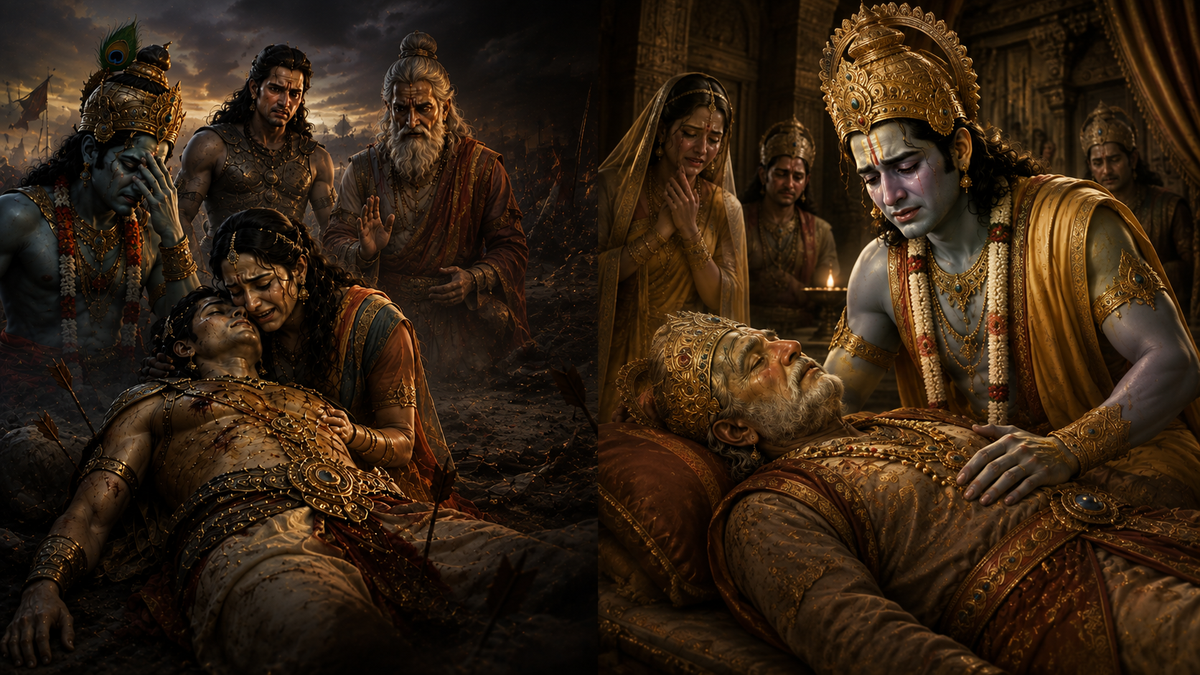
Consider Abhimanyu. His maternal uncle was Lord Shri Krishna Himself; his father was Arjun, a saint; and the one who performed his marriage was Ved Vyas, an incarnation of God. He blessed Abhimanyu's wife, Uttara, saying, "Saubhāgyavatī bhava" (may you remain ever fortunate). And yet that very same Uttara became a widow. Her husband, Abhimanyu, had to depart alone. Everyone was there, and even Lord Shri Krishna was grieving. Someone might say, "Stop him! Don't let him go!" But no - the law must be followed.
King Dashrath, Lord Ram's own father, passed away while Lord Ram was right there. When even these great beings could not stop death, what can ordinary people do?
So always keep this thought in mind: We have come alone, and we will go alone as well. Mother, father, son - all will be left behind. Only the good and bad karmas we have performed will go with us. We will have to depart according to how we have used our body, mind, and wealth.
If we have performed wrong actions, there will be great suffering, and we will have to go to hell. Why didn't you think of this earlier? When the saints told us, "Take out time and engage your body, mind, and wealth in the service of God," we would say, "Guru Ji always talks like this. But we are householders. We have to work for the sake of our children."
But where are the children after death? You will go alone, my friend - none of the children will go with you.
In the kingdom of King Bhoj, there lived a poor Brahmin. To arrange his daughter's wedding, he begged for alms in many places, but he could not obtain any money. After thinking deeply, he finally decided to break into the king's palace and steal something. He devised a plan to enter the palace. Disguising himself as a woman and covering his face with a veil, he entered the palace along with the women.
He then entered the queen's chamber, where the king slept. This Brahmin was well-versed in all the scriptures and Vedas. So whenever he reached out to steal something, he would immediately remember from the scriptures that stealing that particular item would lead to a particular hell. There are twenty-eight great and terrible hells. Stealing gold, silver, diamonds, or cloth each leads to a different hell. So the moment the relevant teaching from the scriptures came to his mind, his hand would stop.
In this way, the entire night passed.
In those days, all sorts of arrangements were made to awaken the king in the morning. Women would sing outside, pandits would recite Vedic mantras, and various musical instruments would be played. As soon as dawn broke, elephants would trumpet loudly and horses would neigh to wake him. This was how the king was awakened.
When all this began at dawn, the poor Brahmin grew anxious, thinking that he would now be caught. If he were caught in the king's own chamber, the punishment would be nothing less than the gallows. So the poor man hid himself under the bed.
Finally, the king opened his eyes. The king himself was a learned scholar, and as he lay there, he composed a verse:
cetoharā yuvatayaḥ suhṛdo'nukūlāḥ sadbāndhavāḥ praṇayagarbhagiraśca bhṛtyāḥ | valganti dantinivahāstarala़āsturaṅgāḥ ...
Ah, just look at this! All around me there is celebration and glory. Elephants are trumpeting, horses are neighing in praise. What can I say of my great fortune!
The king sang these three lines, but he was slow to compose the fourth line of the verse. Meanwhile, the pandit hiding beneath the bed completely forgot that he was a thief and that he was hiding there, about to be caught. He composed the fourth line himself and spoke it aloud:
sammīlane nayanayornahi kiñcidasti -
"O King! When these eyes close in death, one will have to go alone. All of this will be left behind."
The king said, "Where did that voice come from?" The palace attendants and soldiers searched and discovered that a pandit was lying under the bed.
When the king asked him how he had entered his chamber, the Brahmin told him everything that had happened. But when the king heard the line the Brahmin had spoken, he was deeply moved. A great sense of goodwill arose in him toward the pandit, because he had spoken the absolute truth: in the end, one has to go alone. All of this will be left behind.
The king was overcome with detachment (vairāgya).
From that day onward, the king made the pandit his Raj Guru. Later, he handed over his kingdom to his son and went into the forest, for he too would have to go alone. He thought that he must prepare as quickly as possible before his departure - no one knows at what moment one may have to leave. Once that moment comes, nothing more can be done.
Recommended books by Jagadguru Shri Kripalu Ji Maharaj related to this topic: