True Devotion – No Desire Apart from the Master’s Will
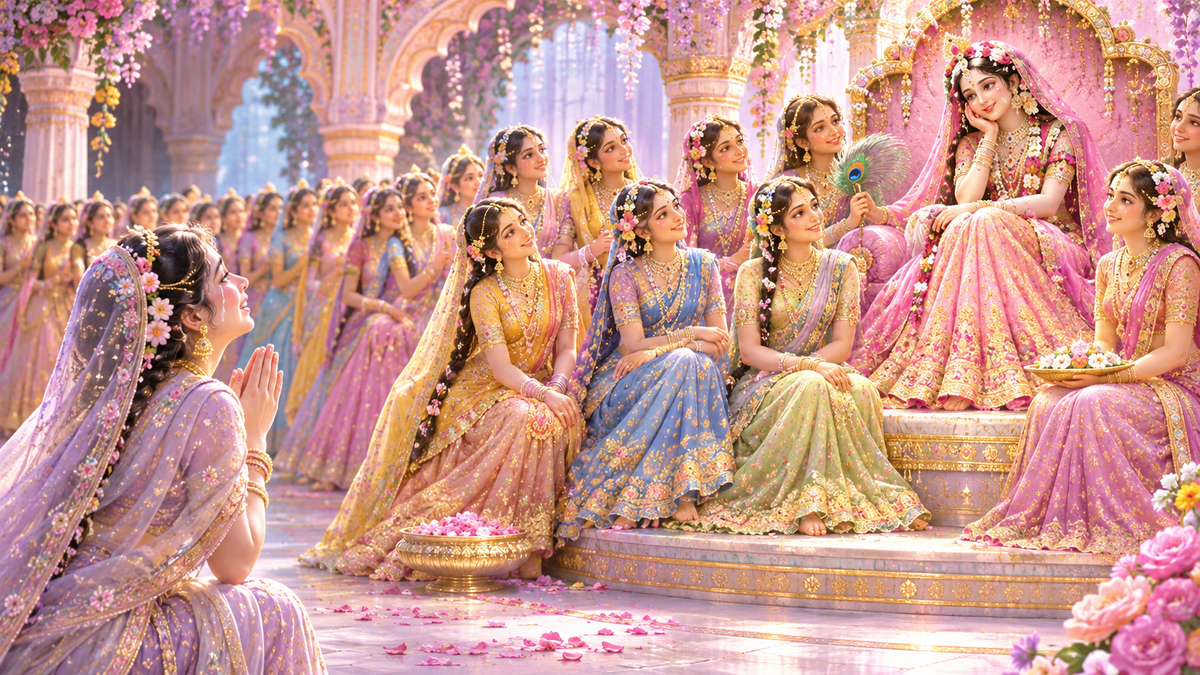
Kirtan explanation - Mohin apni karu Radhey, Radhey meri Radhey (Yugal Shatak, page no. 129, kirtan no. 68)
A devotee who has the sentiments of a Gopi humbly appeals to Radharani - "O Radharani, please make me Yours. Shower such grace upon me that, residing in Barsana and Vrindavan, I may behold your childhood and adolescent pastimes at every moment, day and night. Whatever seva You or Your maidservants assign to me, I will perform it, considering it to be the greatest fortune of my life."
In the divine abode of Golok, a divine order holds that the services rendered by Lalita, Vishakha, and the other Mahasakhis cannot be given directly to any soul. Shri Radha has eight intimate sakhis (kinkaris), and those maidservants, too, have their own sub-maidservants - thus a sequence continues in that manner. Therefore, whatever position your Guru occupies in Golok, you will attain a place immediately behind them. Suppose your Guru is an incarnation of Lalita, Vishakha, or another mahasakhi - then your position will be right behind them. According to Her wish, Radharani may sometimes assign a seva directly to a maidservant in the lower sequence, or sometimes instruct a higher one to convey it.
The devotee says, "O Kishori Ju! Whatever You or Your maidservants gives me, I shall obey it gladly. I have no condition - whichever service You grant, I will accept that alone. But if You ask me, "Which service do you desire?", I will say, "Please grant me service in Your palace."
Never forget this statement until you attain God - to joyfully align your desires with that of the master is true devotion.
Shri Krishna gave Kubja the position of Goddess Lakshmi. But the Gopis said, "If Shri Krishna is happy in Mathura, He should remain there and never return to us." The gopis' quarrels with Shri Krishna are only superficial, not from the heart. God realized that saints experience two types of feelings - sometimes separation (virah) and sometimes union (milan). The Gopis' sarcastic words express the state of separation. They do not reflect their true emotions.
So, the true meaning of seva is to be happy in His happiness, and not to apply one's own intellect, aligning one's desires with the Master without using the intellect. The sole purpose is to give Him happiness - so that no crease ever appears on His forehead, and that the smile never leaves His lips. Being mindful of this is true seva. It is understandable that the soul has limited knowledge and certainly does not know the desires of the Guru and God. But as far as possible, you should not say or do anything that pains Them. If you cannot give Them joy, at least do not cause Them pain. If you become concerned about your own happiness, it will undoubtedly lead to your downfall. Being aligned with Their desires may indeed be difficult in the beginning. But if you do not practice, you can never become worthy of Their grace. Therefore, practice. If your intellect ever starts to think contrary to your Guru's desire, reproach it, shed tears of remorse, and ensure you do not repeat such a mistake.
Furthermore, the devotee says, "O Kishori Ju, listen to me further. It is alright even if You do not make me your own. But my final resolve is that You were mine, and You shall always remain mine. For eternity, I will consider You as my own. This is my unwavering principle." When a devotee develops such firm conviction, Radharani has no other option but to think, "Now, I have no choice but to bestow My grace upon this one."