The Truth About Happiness No One Tells You
Every person in the world is unhappy, restless, and dissatisfied. At every moment, everyone is striving in search of something undefined.
What is that undefined thing?
It is that which removes all sorrow - the bliss we call happiness.
We seek freedom from sorrow, but that is not our true goal. Our real goal is the attainment of divine bliss. Once bliss is attained, sorrow automatically disappears. But merely becoming free from sorrow does not result in attaining bliss.
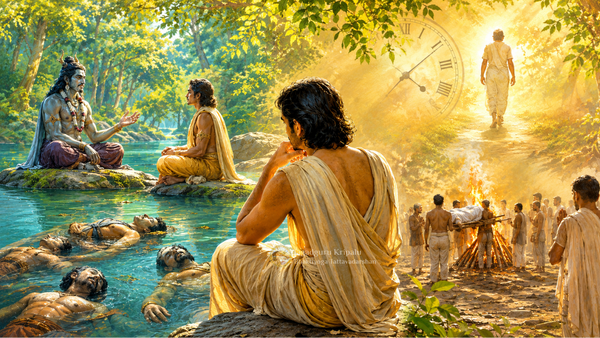
In fact, all of you experience freedom from sorrow every day. When you are in deep, dreamless sleep, you are free from all sorrow. Even if your son were lying gravely ill beside you - or even if he were to pass away - you continue sleeping peacefully, unaware of it, snoring. At that moment, there is no sorrow, but neither have you attained bliss. Why? Because the moment you wake up and learn that your son has died, sorrow overwhelms you once again. Therefore, if sorrow returns after what appeared to be happiness, that cannot be called true bliss.
Yo vai bhūmā tatsukhaṁ
The Vedas say - true bliss is that which is infinite and attained forever. Sorrow cannot have dominion over bliss, just as darkness cannot have dominion over light. Why? Because bliss is the very nature of God.
Āānaṁdo brahmeti vyajānāt। raso vai saḥ
The Vedas do not merely say that God 'possesses' bliss; they declare that God Himself is Bliss. Sorrow cannot have dominion over bliss because sorrow is the nature of māyā, whereas bliss is the nature of God. And since māyā can never overpower God, sorrow can never overpower bliss.
Whatever happiness the world offers has three characteristics:
i) It is limited. The happiness obtained from any worldly object is always finite.
ii) It gradually diminishes with every passing moment. Whatever happiness one experiences steadily decreases until it eventually comes to an end. In time, that very object becomes the cause of sorrow. For example, suppose a mother's child goes missing and is found after four days. The moment she sees him, her joy is overwhelming. She embraces him with immense delight. When she embraces him a second time, her joy is slightly less. The third embrace brings still less joy, the fourth even less, and by the fifth she simply says, "Go on, son. Go and play." The happiness steadily decreases.
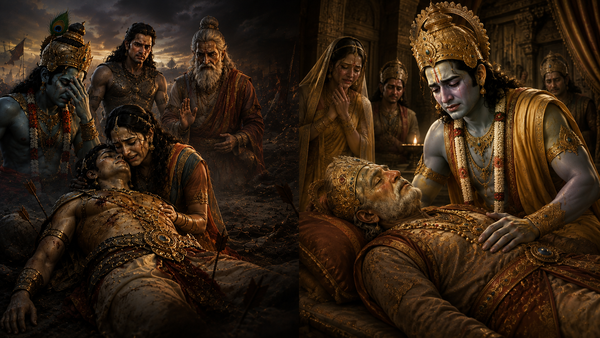
iii) One day, it comes to an end altogether, and the very object that once brought happiness becomes the cause of sorrow. So much so that a husband and wife who once vowed, "We shall live together and die together," eventually stop speaking to one another and begin saying, "Marrying you ruined my life."
Such is the happiness of this world.
And the state of everyone is the same - whether one is a king, a beggar, or an ascetic. The happiness a cow experiences while eating fresh green grass is essentially the same a prime minister experiences while eating a rasgulla. There is no difference in the quality of happiness itself. The only difference lies in our perception from a distance. Whenever we see something we ourselves do not possess, we imagine, "Look at that magnificent house he lives in. How happy he must be!" But the person who actually lives there considers it just ordinary. It gives him no special happiness.
And real happiness - spiritual happiness, the bliss of God - has three characteristics:
i) It is infinite.
ii) It is attained forever.
iii) It increases at every moment. Guṇarahitaṃ kāmanārahitaṃ pratikṣaṇaṃ vardhamānaṃ.
Such is the bliss that we truly seek.
And yet, countless births have passed, and we still have not attained it.
Why not?
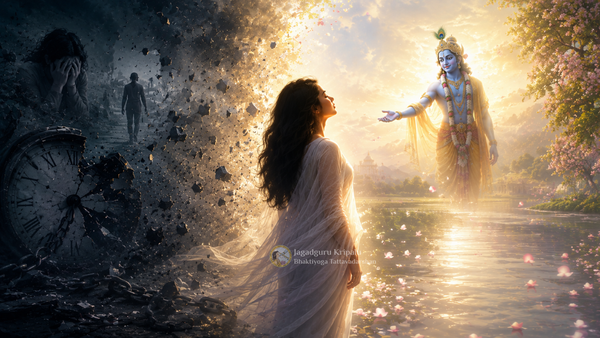
Because of māyā. God's power of māyā has held us under its influence. As a result, we have forgotten our true identity.
This is where everything went wrong.
The very first lesson is this: we are the soul, but we have forgotten who we really are. Instead, we have mistaken ourselves to be the body. Worse still, we have adopted additional false identities based upon the body. We now identify ourselves as man or woman, Brahmin or Kshatriya, Punjabi or Bengali, and so on. All these identities belong to the body - not to us.
Mamaivāṁśo jīvaloke jīvabhūtaḥ sanātan
We are the soul, and we are the eternal parts of God. God is divine; therefore, we too are divine. Just as a sun-ray is part of the sun, we are eternal parts of God.
Thus, all sorrow arises from the delusion of identifying ourselves with the body.
In the Bhāgavatam, Vedavyās has beautifully described this truth in a single verse. This verse is especially dear to Shri Maharaj Ji:
Bhayaṁ dvitīyābhiniveśataḥ syādīśādapetasya viparyayo'smr̥tiḥ। tanmāyayāto budha ābhajettaṁ bhaktyaikayeśaṁ gurudevatātmā
The nine Yogeshwars tell King Videha Nimi that since beginningless time, the soul has remained turned away from God.
This truth applies not only to human beings but to every body you have ever received - whether as a dog, a cat, a donkey, or any other living being.
Dvā suparṇā sayujā sakhāyā samānaṁ vr̥kṣaṁ pariṣasvajāte (Veda)
Within your heart dwell two beings - you and your Father, God. But God stands silently behind you.
sākṣī cetā kevalo nirguṇaśca
He never disturbs you. He merely observes and takes note of everything - every thought that arises in your mind and every action you perform.
Because you have turned away from God, māyā has overpowered you and caused you to forget your true identity. You have accepted yourself to be the body and have begun to regard bodily pleasures as your own happiness. The senses seek happiness from the world. The eyes say, "Go and see Delhi. Then Calcutta. Then England. Then America. Now go and see the moon." This endless craving to see never comes to an end. In the same way, each individual sense has held you captive. The tongue says, "What have you prepared? Dal and roti again? Do something different." A tiny tongue has an infinite variety of foods before it, yet it never becomes satisfied. How much of the world can anyone possibly see? There are infinite Brahmāndas. No one can see even a single Brahmānd in its entirety. And even if someone could see them all, the senses would still remain unsatisfied.
Bahvya: sapatnya iva gehapatiṁ lunanti
The Bhāgavatam compares the five senses to five co-wives, each pulling the same husband toward herself. These are the five gyānendriyas - the senses of sight, hearing, smell, taste, and touch - and each has an infinite variety of objects to enjoy.
Why are there so many legal disputes over land in this world?
Yatpr̥thivyāṁ vrīhiyavaṁ hiraṇyaṁ paśava: striya: nālamekasya paryāptaṁ
Even if all the infinite universes were legally transferred to one person, he would still not be satisfied, because you are the soul, and the material world is simply not your true domain.
The eye and the ear are both made of the five gross elements - earth, water, fire, air, and ether. Yet we cannot see through our ears, even though the entire body develops from the same material in the mother's womb. This is because the eye contains a greater proportion of the fire element (tej), enabling it to perceive light.
Therefore, if the eye - made of the five gross elements - cannot perform the function of the ear, another organ made of those very same elements, then how can the soul - which is divine - ever be satisfied by material objects?
No matter how much of the world you give it, its desires only continue to grow.
Girirmahān girerabdhirmahānabdhernabho mahat। nabhaso'pi paraṁ brahma tato'pyāśā duratyayā।
A mountain is vast. Greater than the mountain is the ocean. Greater than the ocean is the sky. Greater than the sky is God. And greater even than that is worldly desire, for it has no end.
Thus, because we have remained turned away from God since beginningless time, māyā has overpowered us and made us forget our true identity. We accepted ourselves to be the body, ran after worldly pleasures, forgot God, and in this way countless births have passed.
Throughout these countless births, we have heard many scriptures and Vedas. We must have approached innumerable saints. We must have nodded our heads and said, "Yes, I have understood."
Bliss can be found only in God or in the saints who have attained God. We never surrendered there. We never took refuge in them. We never developed a sense of belonging with them.
Why?
Because our intellect remains firmly convinced that happiness lies in the material world.
Having turned away from God, we bow our heads everywhere else, begging, "Please give me happiness." But the other person replies, "I myself am a beggar. What can I give you? I possess no bliss." Thus, everyone seeks happiness from everyone else, and all remain beggars. It is as foolish as one blind man holding the hand of another blind man in an attempt to find the way.
If only we had placed our faith in God, then -
Astītyevopalabdhasya tattvabhāvaḥ prasīdati. (Vedas)
If you simply accept, "God exists, and He is seated within my heart," you will attain Him.
But we do not truly believe it. We simply do not accept it.
Suppose a gold coin is lying on the ground. No one dares pick it up because of the fear, "If someone sees me, I will be greatly disgraced." In other words, people fear other human beings far more than they fear God, even though He is seated within them, witnessing everything they think and do. Stealing gold is counted among the five great sins.
Therefore, one must realize God's presence everywhere and at all times, and cultivate love for Him alone. That love should continue increasing, and so should our affectionate attachment to Him. There are no rigid rules or regulations for this. No particular mantras or rituals are required. No scholarship in the scriptures or the Vedas is necessary. Just as you naturally love your mother, your father, or your child, love God in exactly the same way. Nothing new has to be done. Simply become firmly convinced that your true self-interest lies in God alone, and that true bliss can be found only in Him.
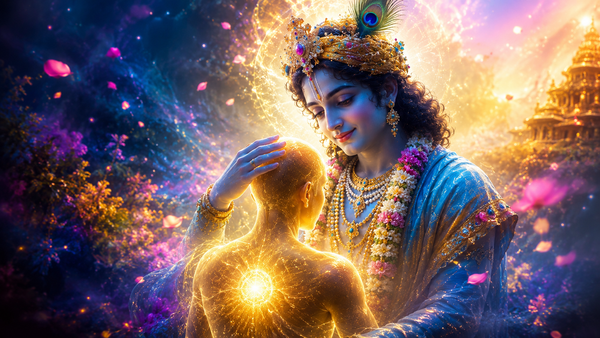
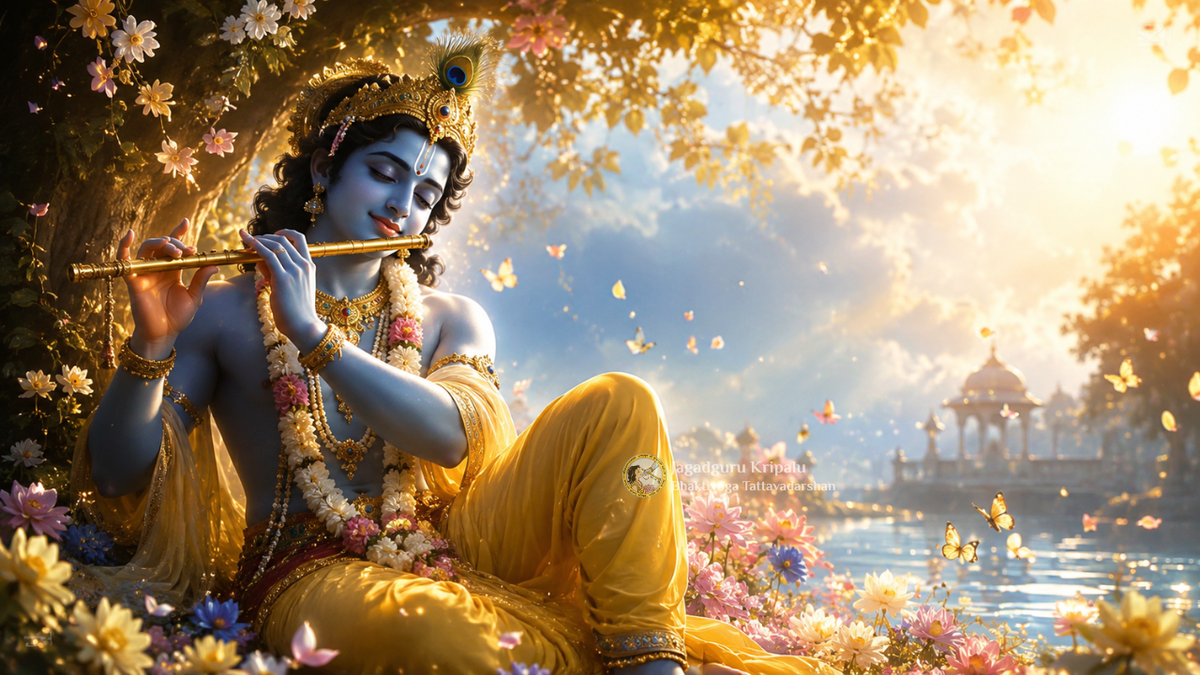
If we genuinely realize that Shyamsundar is seated within our own hearts, love for Him will arise naturally and without delay, and our goal will be attained.
Therefore, strengthen this conviction again and again through repeated contemplation. Wherever you go, constantly feel:
"Shyamsundar is seated in my heart." Deepen this feeling again and again. That alone is necessary. Your goal will be attained. Love will arise naturally - you will not have to force it.
Recommended books by Jagadguru Shri Kripalu Ji Maharaj related to this topic: