The Life Force of Devotion
Whether you chant God's names or write them down, these are external, physical activities. Devotion performed merely through the senses is not considered true devotion.
manera smaraṇa prāṇa - remembrance through the mind is the very life of devotion.
The existence of the soul is paramount in the body. The moment the soul departs, all the organs and limbs become inert and useless. It is only because of the subtle soul's presence that the entire body remains alive and functional. Similarly, remembrance through the mind is the life force of all devotional practices. Speaking, listening, reading scriptures, singing kirtan, or performing worship are all activities of the senses. They become true devotion only when the mind is attached to God.
Each person's devotional practice may differ according to the mental impressions (sanskārs) accumulated over countless lifetimes. Therefore, many methods of devotion have been prescribed. One may choose whichever method naturally appeals to the mind. However, the essential principle remains the same. As stated in the Bhagavatam -
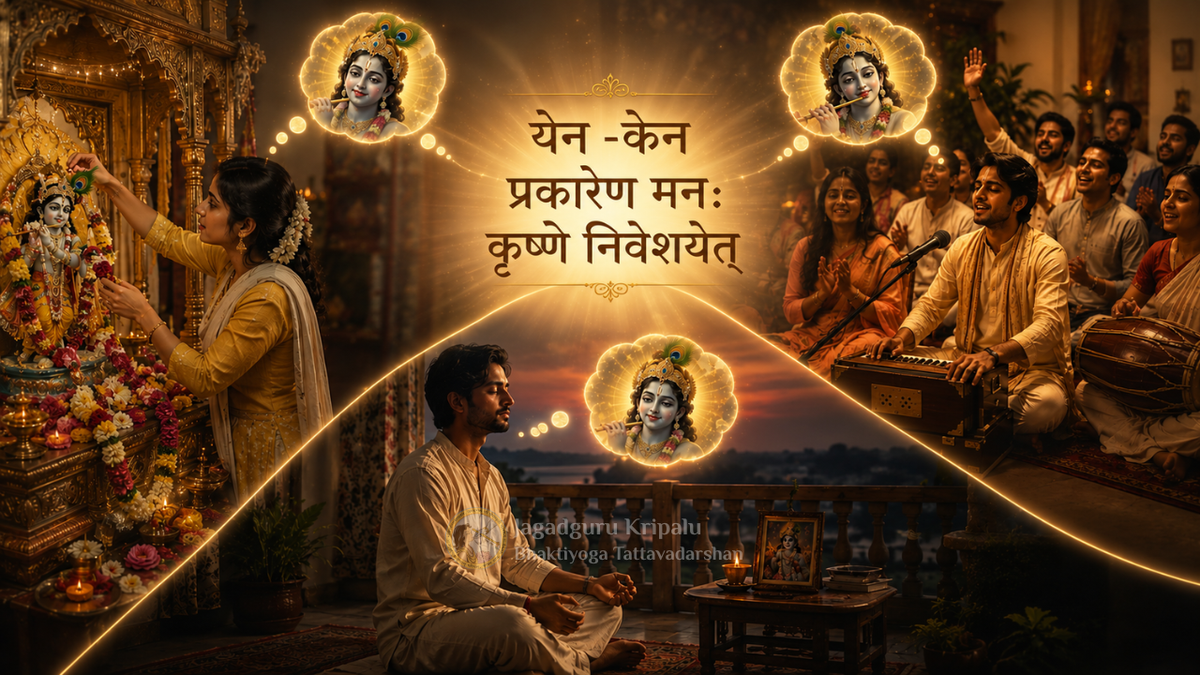
yena kenāpyupāyena mana: kṛṣṇe niveśayet
By whatever means possible, one should attach the mind to Shri Krishna.
saba sādhana kara yaha phala suṃdara।
tava pada paṃkaja prīti niraṃtara।
The beautiful fruit of all spiritual practices is unceasing love for the lotus feet of the Lord.
There are countless forms of spiritual practice. Just as people have different preferences for foods, sweets, and clothing colors, aspiring devotees are naturally attracted to different forms of worship according to the mental impressions they have carried from previous lives. Therefore, there is no rigid rule that everyone must follow the same method.
If someone feels more devotion while decorating and worshipping the deity with an awareness of God's presence within it, they should follow that practice. Similarly, if another person finds it difficult to concentrate during group sankirtan but can practice Roopdhyan more effectively in solitude, they should follow that method instead. One should adopt whichever practice helps the mind become absorbed in God.
However, regardless of the method chosen, two principles must always be present:
- Loving remembrance of Shri Krishna.
- An ever-increasing longing to meet Him.
If these two elements are present, your devotional practice is on the right path. If they are absent, something needs to be corrected.
Devotee's Question -
In the beginning stages of spiritual life, should an aspirant focus only on bhakti or both bhakti and gyan? Some people say that if one practices only devotion, one may become lazy, dependent, and unable to function effectively in the world.
Shri Maharaj Ji's Answer -
One should practice devotion alone. Bhakti does not depend upon Gyan, Karma, Yoga, or any other path.
na jñānaṃ na ca vairāgyaṃ prāyaḥ śreyo bhavediha -
Gyān, Vairāgya, Karma, and Yoga do not assist devotion; rather, they tend to create obstacles to it. Gyān, in particular, can become a formidable hindrance when pursued independently of devotion.
Bhakti is complete in itself. It begins with the nine forms of devotion, continues through those same practices, reaches perfection, and remains eternal thereafter.
Other spiritual paths require specific qualifications and eligibility. The path of devotion does not. The scriptures declare:
sarve'dhikāriṇo hyatra
Everyone is qualified for devotion. Even Valmiki, who initially could not utter the name "Ram," became a great saint through the power of devotion.
However, in our country, perhaps only one person among millions has firmly grasped this philosophical truth: first bring God before your mind, and then perform whatever worship, recitation, chanting, or spiritual practice you wish.
Spiritual teachers do not explain this to people. Many narrate the stories of Ram and Shyam on television, but that is only a matter for the ears - what will come of that alone? Look instead at how much your mind is attached to God.
Devotee's Question - How should one practice remembrance?
Shri Maharaj Ji's Answer -
Keep a picture of the form of God that appeals to your heart. Look at the picture carefully, then close your eyes and try to recreate that form within your mind. Repeat this process again and again - look, close your eyes, and visualize.
With regular practice, you will eventually be able to create that form in your mind without needing to look at the picture. Those who cultivated this practice in previous lives do not even require a picture; they can immediately visualize the Lord.
You are not restricted to meditating on only one particular form of God. Visualize whichever form attracts your mind - whatever age, attire, pastime, or mood appeals to you. God has given complete freedom in this regard.
No one can claim that they cannot practice devotion because they have not studied the scriptures, do not know the Vedas, or lack the faculties of sight or hearing. The essential requirement is simply this: lovingly remember God with your mind.
Before attaining God, no one can visualise His original divine form exactly as it is, because the material mind can only create a material image. Nevertheless, God's compassion is so great that He accepts that material image, when formed with loving devotion, as though it were His own divine form.
When the mind becomes purified through devotional practice, and one receives divine grace through the Guru, divine remembrance becomes possible. God cannot be perceived through material senses, the material mind, or the material intellect.
Throughout countless lifetimes, we have witnessed God's innumerable descensions. Yet, due to our habit of applying material reasoning, we judged those divine manifestations through the intellect, perceived faults where none existed, and thereby harmed our own spiritual progress.
Recommended books by Jagadguru Shri Kripalu Ji Maharaj related to this topic: