The One Kind of Bhakti That Leads to God
Although there are many forms of devotion, Lord Kapil explained to His mother Devahuti that all devotion can ultimately be classified into four main categories. Every other form of devotion falls within one of these four.
Why Only Four Types?
Because apart from the soul, there are only two realities:
- Maya, and
- God
Maya operates through three qualities (guṇas):
ajāmekāṃ lohitaśuklakṛṣṇāṃ -
- Sattva (goodness) - symbolised by white
- Rajas (passion) - symbolised by red
- Tamas (ignorance) - symbolised by black
Accordingly, devotion can be influenced by these three modes, or it can transcend them altogether.
Therefore, the four types of bhakti are -
- Tamasic bhakti - abhisandhāya yo hiṃsāṃ -
Devotion practised for violence, etc., or dambhaṃ mātsaryameva vā - for hypocrisy, deceiving the world, increasing one's pride, for jealousy and hatred - is called tamasic bhakti. - Rajasic bhakti - viṣayānabhisandhāya yaśa aiśvaryameva vā -
Devotion practised with the desire to attain fame or material opulence, such as becoming a king or a billionaire, is called rajasic bhakti. - Sattvic bhakti - karmanirahāramuddiśya parasmai vā yadarpaṇaṃ -
Devotion practised with the aim of getting liberated from the bondage of karma and done with the spirit of sincerely offering it to God, is called sattvic bhakti.
Among these three types of devotion,
Sattvic bhakti is better than rajasic bhakti, while tamasic bhakti is utterly condemnable. However, all three remain within the realm of Maya.
Collectively, they are forms of bhukti (devotion done to fulfil some material desire), because they are motivated by personal gain.
They may grant:
- Material prosperity
- Heavenly enjoyment
- Elevated positions up to Brahmaloka
But they do not grant God-realization or freedom from Maya.
A person who gains true spiritual knowledge through the association of a genuine saint renounces all three from afar.
- Nirguṇa Bhakti - Beyond the three modes of Maya lies the fourth kind of bhakti - Bhagavad-bhakti - pure devotion to God -
madguṇaśrutimātreṇa mayi sarvaguhāśaye। manogatiravicchinnā yathā gaṅgāmbhaso'mbudhau ॥
lakṣaṇaṃ bhaktiyogasya nirguṇasya hyudāhṛtam।ahaitukyavyavahitā yā bhakti: puruṣottame ॥
There are certain conditions in this -
i) Devotion must be directed towards God and Guru alone -
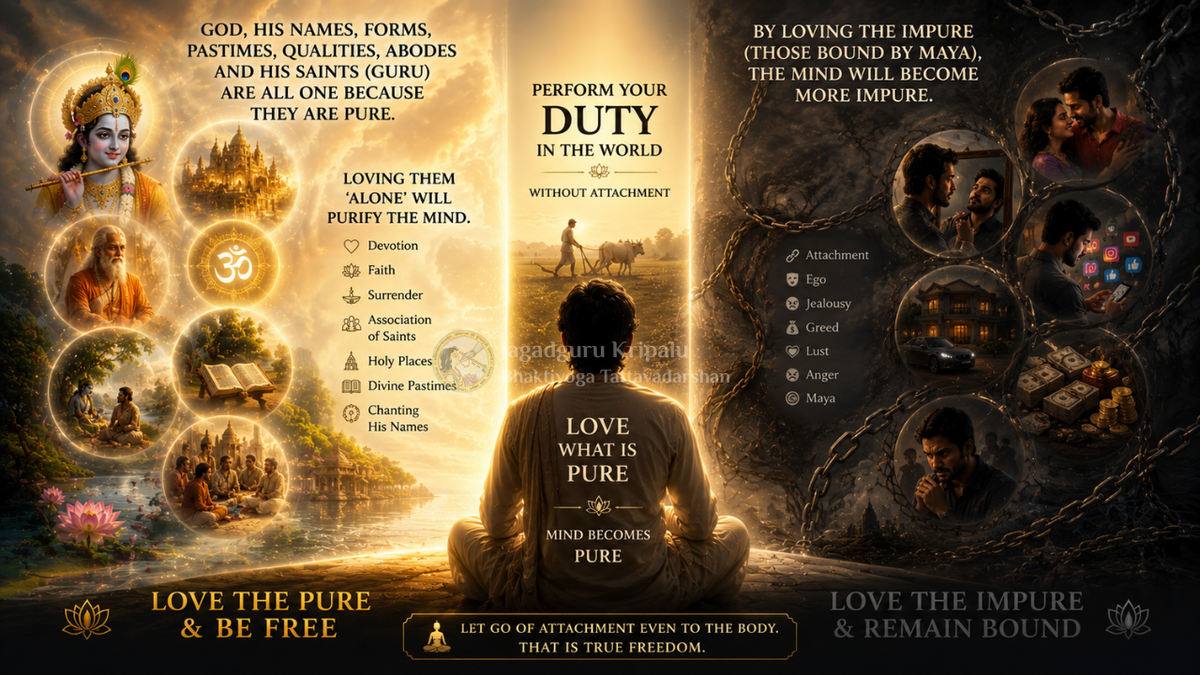
God, His Names, Forms, Qualities, Pastimes, Abodes, and His saints are not different from Him. Since they are divine, attachment to them purifies the mind.
ii) Devotion must be continuous and uninterrupted, just as the river Ganga flows continuously from Gangotri to the Bay of Bengal. People practice devotion for half an hour or two and think that is enough. They earn two rupees but spend twenty-two. This means that in twenty-four hours, they clean the cloth (mind) with soap for two hours, but smear dirt on it for the remaining twenty-two. This is because the mind remains in the three modes of Maya, as the mind cannot remain inactive even for a moment - na hi tiṣṭhati kṣaṇamapi jātu tiṣṭhatyakarmakṛt. No embodied being can remain inactive even for a moment. Before performing any action, one must bring the mind there. And there are only two realms - if the mind is not absorbed in God, it is absorbed in the world. One cannot say that their mind is neither in God nor the world. It is another matter if you are unable to read the state of your mind.
iii) Devotion must be 'ahaitukī' - selfless - without any reason or motive. Do not ask for anything from God. You have wandered through 8.4 million life forms in countless births, asking for things in every birth. If you must have a desire at all, then desire only His darshan, and when you meet Him, remain silent and ask for nothing. Simply say, "I will wish what You wish. I want to give You happiness, and I want to become Your servant."
iv) 'Avyavahitā' - meaning exclusive devotion - this is the final condition. It is not acceptable to practice devotion to both Maya and God. You cannot distribute your love among your mother, daughter, saint, and God - such an approach will not work. Yes, if someone's son happens to be a saint or God Himself, then that mother may love her son. Such a son ensures that his mother attains Golok.
yeṣāmahaṃ priya ātmā sutaśca sakhā guruḥ suhṛdo daivamiṣṭam॥
Lord Kapil says - I am not merely the son; I am the soul of all beings. I am a mother, father, husband - everything.
During God's descensions, those who loved God without regarding Him as God all attained Golok. The Gopis - whose foot-dust is desired by Brahma and Shankar - did not consider Shri Krishna as God. On several occasions, Shri Krishna revealed Himself to them through miracles as God, yet they did not accept Him as God. Generally, if someone abuses God, it's considered a grave offence - nāmaparādh. However, even when the Gopis hurled a thousand abuses at Krishna, He would say, "I would like to hear more of this; it feels sweet!" This was because the Gopis abused Him, knowing it brought joy to Shri Krishna.
So, in essence, God, His names, forms, pastimes, qualities, abodes, and His saints (Guru) are all one because they are pure. Loving them 'alone' will purify the mind. By loving the impure (those bound by Maya), the mind will become more impure. You must simply perform your duty in the world. You must let go of your attachment even to the worldly objects, including attachment to your own body.
So remember these conditions -
i) 'Hari-Guru bhaju' - Do devotion to Hari Guru,
ii) 'nita' - continuously,
iii) 'bhāv nishkām' - ahaitukī - selfless devotion, and
iv) 'ananya' - avyavahitā - exclusive.
In this single couplet, Shri Maharaj Ji has encapsulated the essence of the entire scriptures and Vedas, as well as Lord Kapil's teachings. You can achieve your goal by memorising this principle and putting it into practice.
Read: