Daily Devotion -May 1, 2026 (English)- Form Before Name
The essence of all scriptures from the Vedas up to the Ramayana is Sankirtan - that is, the singing of the names, qualities, and pastimes of God.
In our country, sankirtan takes place in great abundance, yet people do not truly take God's name. Taking the name of God does not merely mean repeating "Ram Ram" or "Shyam Shyam." Nor does it mean whispering a mantra into your ear. The true meaning of taking God's name is this: first, establish the divine form of God in your mind, bring Him before you, and only then take His name. That is, the name must always be taken together with Roopdhyan (lovingly meditation on His divine form). Whether you do japa, recitation, or anything else, Roopdhyan is foremost - and this is precisely what you most often forget. In our country, many grand forms of worship take place, yet corruption is also at its peak - because we do not truly take the name of God; we merely pronounce it. Our Vedas, scriptures, and Puranas declare -
tajjapastadarthabhāvanam
Whatever name you take, cultivate the feeling that corresponds to it and engage your mind fully in it.
Words like detachment (vairāgya), attachment (anurāg), and love (prem) belong to the mind, not to the body. Detachment from the world is also a matter of the mind, not merely of outward renunciation. If a person goes and sits in a forest but his mind remains absorbed in the world, he will attain only the world even after death, for whatever feeling occupies the mind at the final moment, that alone is attained.
yaṃ yaṃ vāpi smaran bhāvaṃ tyajatyante kalevaram। taṃ tam evaiti kaunteya।
The mantra that babas commonly whisper into the ear means: "O God, I bow to You. O God, I take refuge in You." This is in Sanskrit. But this very sentiment can be expressed in Hindi, Bengali, Punjabi, Tamil, or any language - God will be no less pleased. For God, there is no distinction of language. God's clear rule is -
mām eva ye prapadyante māyām etāṃ taranti te।
Only the person who attaches his mind to Me can attain Me.
mana eva manuṣyāṇāṃ kāraṇaṃ bandhamokṣayoḥ, cetaḥ khalvasya bandhāya muktaye cātmano matam - and so on. The conclusion of all scriptures is that the mind alone is the cause of both bondage and liberation. God does not take note of the recitation of the Ramayana, the Gita, the Bhagavat, or the Vedas done with the mouth - He rather takes note of the attachment of the mind.
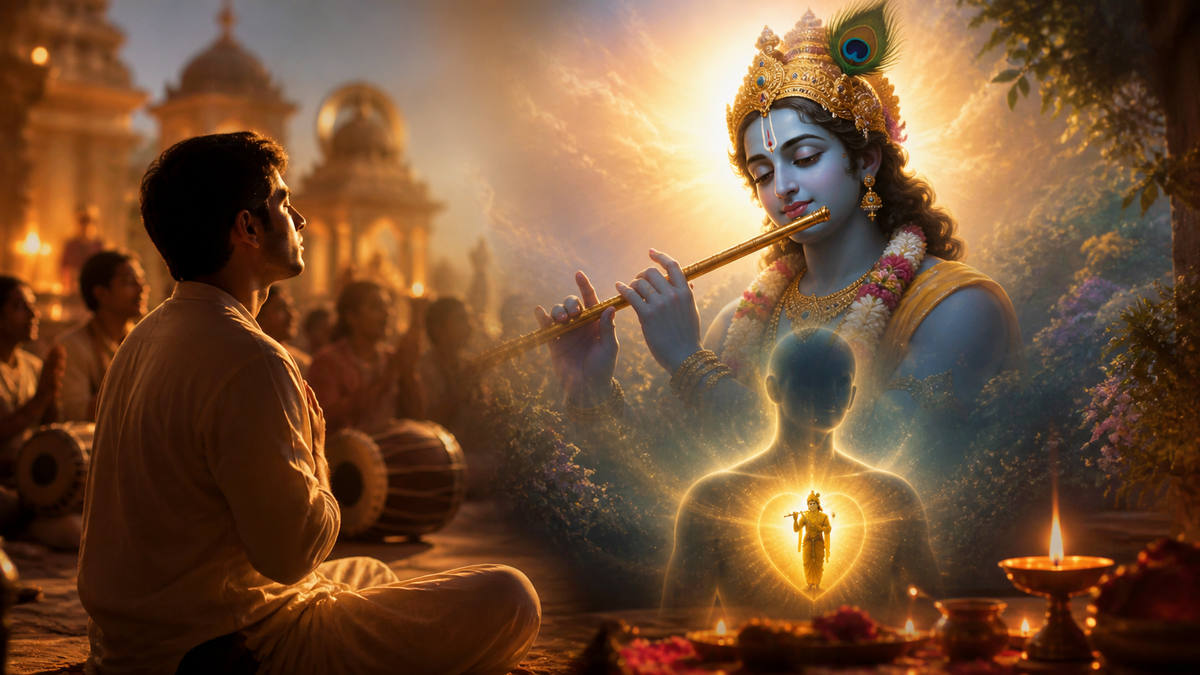
Therefore, the correct sequence of worship is this: first, meditate on the form of God. After that, take His name. Even in the world, when you call someone, you first bring their form to mind - for example, before calling out to Ramesh, you first picture Ramesh in your mind, and only then speak his name. But when you take God's name, God is absent from your mind. The mind is observing who is sitting next to you, what drums are playing nearby, who is dancing, and so on. This is not worship. This is deception toward God. The mind is in the world, and the senses are engaged in God - this is reverse Karmayog.
You need not even take a single name of God. Simply contemplate Him continuously with the mind.
ananyacetāḥ satataṃ yo māṃ smarati nityaśaḥ, tasyāhaṃ 'sulabhaḥ' pārtha
God Himself says: the person who constantly remembers Me with his mind (satataṃ smarati) - for him I am very easy to attain (sulabhaḥ).
God is not only in temples or places of pilgrimage; He pervades every heart and is fully present everywhere. We hear this, but you do not truly accept it - and that is why you commit sins. If you were to genuinely realize at all times and in all places that God is seated within you, that alone would lead to God-realization.
God says -
astītyevopalabdhasya tattvabhāvaḥ prasīdati -
Simply accept that I always dwell in your heart. Accept this always, just as you realize the existence of your own "I" - that I exist. The "I" that was in Delhi yesterday is the same "I" that is here now. The "I" that slept last night is the same "I" now. In the same way, wherever "I" am, there too is my divine father - God. The child and his provider God - both reside in the same place.
So Roopdhyan is itself worship. Along with it, do kirtan, bhajan, puja, and recitation - all of that is fine. But remembrance of the mind is the very life-breath of devotional practice. If that life-breath is gone, everything else is merely a physical drill - it amounts to nothing. Mother Yashoda never chanted "Hare Ram Hare Ram" - she would say, "Hey Kanua! Come here. Hey Balua! What are you doing?" Her mind was filled with love for God - that is the real thing.
Rāmahi 'kevala' prema piārā।
milahiṃ na raghupati binu anurāgā। kie joga japa gyān birāgā।
One must lovingly meditate on the form of God and call out to Him with tears. Write this sentence in golden letters - you may accept it today, or you may accept it after suffering through the eighty-four lakh species across millions of births. But you will have to accept it. God must be called out to with tears, like an innocent child crying out.
ādyāgamad yadi śravat sahasriṇībhir ūtibhiḥ
The Veda says - call out to Him with tears, and He will come out from within.
Do not pretend - mohi kapaṭa chala chhidra na bhāvā. God does not like pretense.
It is not necessary that you must bathe and purify yourself first. Just as in the world, you love your mother, father, spouse, or children always and everywhere - you do not think, "Let me first bathe, or face east, and then love them in my heart."
And a question arises: since we have not seen God, what form should we visualize?
For this, God has said: "Your body is made of maya, and your mind too is made of maya. So the contemplation of your mind will also be material -
go-gocara jahaṃ lagi mana jāī। so saba māyā jānahu bhāī।
But I will accept the contemplation of your mind as real contemplation and give you the real fruit."
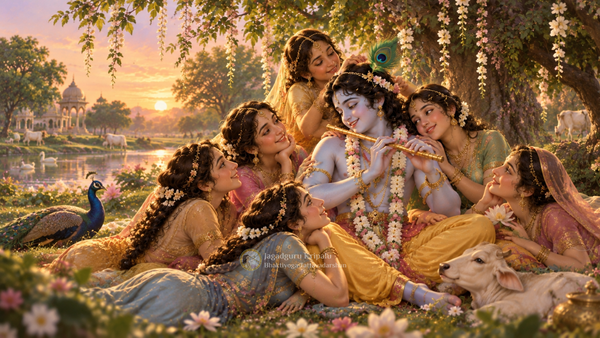
Our Father is so compassionate. So you can visualize any form of God that pleases your mind - black, yellow, blue, tall, stout, slender, small, or large - whatever you wish. Everyone's preference is different. That is why God says - Create a form according to your own preference.
manomayī maṇimayī pratimāṣṭavidhā smṛtā (Bhagavat)
It is difficult to cultivate the feeling of God in a stone idol, because if one wishes to adorn Him with a diamond garland, an ordinary person cannot do so. And if tears do not come during worship, that is merely self-worship - not the worship of God. Instead of displaying one's worldly status, one should feel that the Lord who is the Master of infinite universes, dwells in my heart - that alone is our real status. Because of pride, one is unable to shed tears even before God. On the other hand, people cry for the world. God says, "Ask Me with tears, and I will give you everything. I walk behind My devotee." But we do not take His name with tears. We perform many actions with our senses and then take pride in having done them. Visiting all four dhams is merely marching with the feet, because even in temples, the mind remains absorbed in worldly thoughts. The mind does not become pure, and God wants only the mind. Therefore, Roopdhyan is the foremost necessity. So, in your mind, create His form and adorn Him according to your desire. Worship must be done with feeling, for God is hungry for loving sentiments. Just as the effect of poison or nectar is certain, so too the mind's attachment to God is the very success of human life - everything else is meaningless. Therefore, one should reflect each day on how much time was given to God and how much was wasted - for the body cannot be relied upon; time must be used well, and in idle time, instead of engaging in worldly gossip, one should contemplate God.
The conclusion of all scriptures is this: while lovingly meditating on his divine form, cultivate an intense longing for His vision, call out to Him with tears, and do not ask from Him for the world or liberation; ask only for His love and His vision - this alone is the ultimate wisdom.
Even after composing the Vedas, Puranas, and the Gita, Veda Vyas remained restless. Then Narad Ji said, "You have not described devotion to Shri Krishna. Therefore, first practice devotion yourself - call out to Shri Krishna with tears, attain His darshan, and only then write the Bhagavat." Then -
apaśyat puruṣaṃ pūrvam -
He practiced devotion, attained the darshan of God, and only then wrote the Bhagavat - and then the goal was attained.
Therefore, Roopdhyan alone is sadhana and worship. Engaging the mind alone is devotion. The remaining physical actions are not primary in God's reckoning. Just as in the world, a crime is judged by the intention of the mind, so too God observes the thoughts of the mind. Sing kirtan along with Roopdhyan - whether alone or in a group. This will purify the mind. Then, by the grace of the Guru and the grace of God, your mind, the eyes, the ears, the nose, the tongue, and the skin will receive a divine power. Then you will be able to see God with these very eyes and hear the words of God with these very ears.
Wherever you go, pause for a moment now and then and feel this - "Yes, He is seated in my heart." Then, even while doing your work, maintain this remembrance that He is seated in your heart. Feel this again and again. You will then remain perpetually enraptured, thinking - "What do I have to fear, when He is seated in my heart?" When such a feeling arises, you will not commit sins either, and your "privacy" from God will end. Any wrong thought or action against anyone will stop on its own - because the feeling will remain that God is watching everything.
Therefore, giving special attention to Roopdhyan, continue your devotional practice constantly.
Recommended books by Jagadguru Shri Kripalu Ji Maharaj related to this topic: