Daily Devotion -Mar 22, 2026 (English)- Faith Formula


Faith is Indispensable in Devotion
Doha Explanation: Saccā sat saccā saṅga Govinda Rādhe. Śraddhā binā bhī śraddhā paidā karā de.
(The true association of a true saint can generate faith even in one without faith.)
The very first thing that must arise in any person is shraddhā (faith). It may arise in any way - whether through the impressions of past lives or through the hardships of the world.
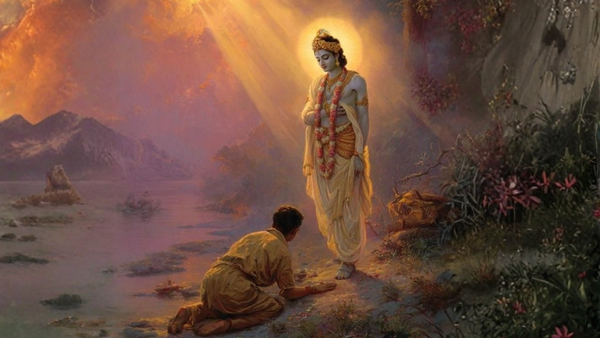
Shraddhā means firm conviction in the teachings of the Guru and the scriptures. Valmiki was such a great sinner that he could not even utter the name "Ram," yet his faith in the words of his Guru was so immense that, even as termites consumed his body, he continued to follow the Guru's instructions without interruption. He kept repeating "Marā marā marā." This is faith - obeying the Guru's instruction without applying your own intellect.
It is the Guru alone who explains to us the meaning of the Vedas and scriptures. Therefore, firm inner conviction in the words of the Guru itself is called faith.
If the Guru gives you a flower and says, "This is an extremely precious thing - keep it carefully," a foolish person thinks, "What is so special about this?" He applies his intellect - "Is what he is saying correct or not?" In this way, he fails to truly understand the Guru's words. For countless lifetimes, we have had the habit of applying our intellect, whether to the words of God or those of the Guru. The conviction that "Whatever He says must be correct" does not arise within us. This indicates a lack of faith.
A seriously ill patient follows every instruction of the doctor without argument. When learning English, we accept all its rules, such as silent letters, without applying our own reasoning. In a bank, we entrust even up to one crore rupees to an employee without doubt. In the world, we trust everyone - our mother, father, brother, wife, husband - we place firm faith in all of them. Yet it is only in matters concerning the Guru and God that we begin to apply our intellect.
Not applying the intellect and accepting 100% - this is what is called sharanāgati. This is faith; this is firm conviction. And this is the innocence of a small child - whatever you tell him, he believes. If such firm conviction were to take root in the words of the Guru, then attaining God would not take long. Our cunningness, our deceitfulness, and our habit of applying the intellect - this is not our true nature, it is merely acquired habit - something we have learned. We must abandon these and restore our original innocence. Then faith will be born.
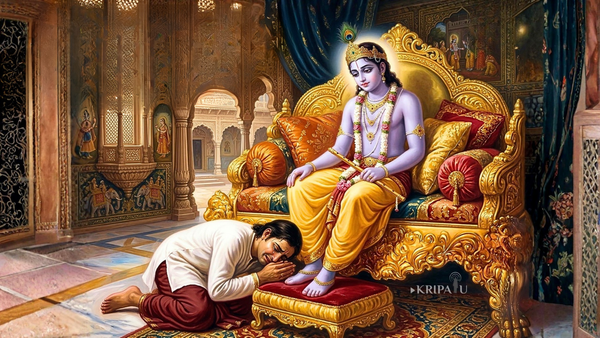
When a person develops true faith, he should go to the Guru. Then he will engage in 'sang' - association. For that, first the 'sat' must be genuine - that is, the saint must be true; the Guru must be genuine. If one keeps merely keeps listening to kathā-vāchaks (those who narrate scriptural stories), even the little knowledge one has will become corrupted, because they lack true tattvagyān - they say one thing at one time and something different at another. Furthermore, the association must also be genuine. The meaning of 'sang' or association is the surrender of the mind and intellect. When there is faith, the mind and intellect will naturally surrender - one will become sharanāgat - completely surrendered. Without faith, true sharanāgati and true association are not possible. Merely bowing at someone's feet is not called sharanāgati. Such a person listens to discourses and praises them, but continues to act according to his own mind. This means he has not truly associated. Association means that the teaching becomes practical - it descends into your actual conduct. If one continues to exercise his intellect, it has not become practical; and where one does not apply the intellect, it has become practical - this itself is the proof of satsang.
Therefore, only if there is true faith will there be true association with a true saint.
Thus, the sequence is as follows -
- A true saint
- True association
- True devotional practice (sādhana)
- True fruit - that is, by engaging in devotion, anartha-nivṛtti (the removal of obstacles) occurs naturally, and material vices fall away on their own.
- Nishthā - steadfastness will arise automatically.
Among these, only three are primary: 1) A true saint, 2) True association, and 3) Bhajan-sādhana (devotional practice).
Therefore, faith comes first - every scripture and Veda declares this.
Ajñaścāśraddadhānaśca saṃśayātmā vinaśyati -
One who is ignorant - who does not understand the tattvagyān - is utterly ruined. And one who has no faith - even if he listens to and understands the words of a true saint - is also utterly ruined, because he keeps engaging in arguments, counterarguments, false reasoning, excessive reasoning, and doubt.
Therefore, faith is absolutely indispensable. The Vedic mantras also declare - Śraddhattsva tāta śraddhattsva -
O human beings, cultivate faith. Place complete trust in the words of the Guru. Do not say, "First give me the experience, then I will believe." Even in the world, without study, you do not obtain a degree; so how can the goal be attained in the realm of God without faith?
Therefore, this is the rule established in all scriptures and Vedas: Ādau śraddhā tataḥ sādhu saṅgo'tha bhajana kriyā. First comes the faith, then the association of a genuine saint, then the practice of bhajan.
However, Vedvyas has also described one exception to this rule:
Satāṃ prasaṅgānmama vīryasaṃvido.....śraddhā ratir bhaktir anukramiṣyati (Bhāgavat)
This means that if someone truly associates 'continuously' with a genuine saint, then even if, in the beginning, he keeps applying his intellect, that tendency will gradually diminish. With repeated explanations from the Guru, he will eventually stop relying on his intellect, and faith will arise within him. He will come to understand that exercising his intellect will bring about his complete ruin. Just as in the world we do not apply our intellect to the doctor, the teacher, or the bank, we should not apply our intellect in divine matters. The Guru repeatedly explains that even the intellects of the greatest yogis cannot reach there; thus, through repeated hearing and understanding, faith will arise.
Therefore, do not apply the intellect in the realm of God; instead, apply it in the realm of Maya. People in the world deceive us by saying, "I love you; I only want your happiness," and we become fools. Remember this formula - wherever someone bows down excessively, greets you again and again, or touches your feet repeatedly, there is a great selfish motive hidden behind it. Stay alert, otherwise you will be deceived. But we do the opposite - we take him to be a good person, while he is, in fact, deceitful, a fraud.
Thus, through satsang - the true association of a genuine saint - even without initial faith, faith gradually arises, and the journey of devotion progresses. Just as a broken-down car is started by pushing it, so too does even unwillingly attending satsang gradually generate faith. Therefore, one should not be disheartened. This is the essential meaning of this doha.
Recommended books by Jagadguru Shri Kripalu Ji Maharaj related to this topic: