Was Lord Ram Really Born? The Truth Behind Ram Navami
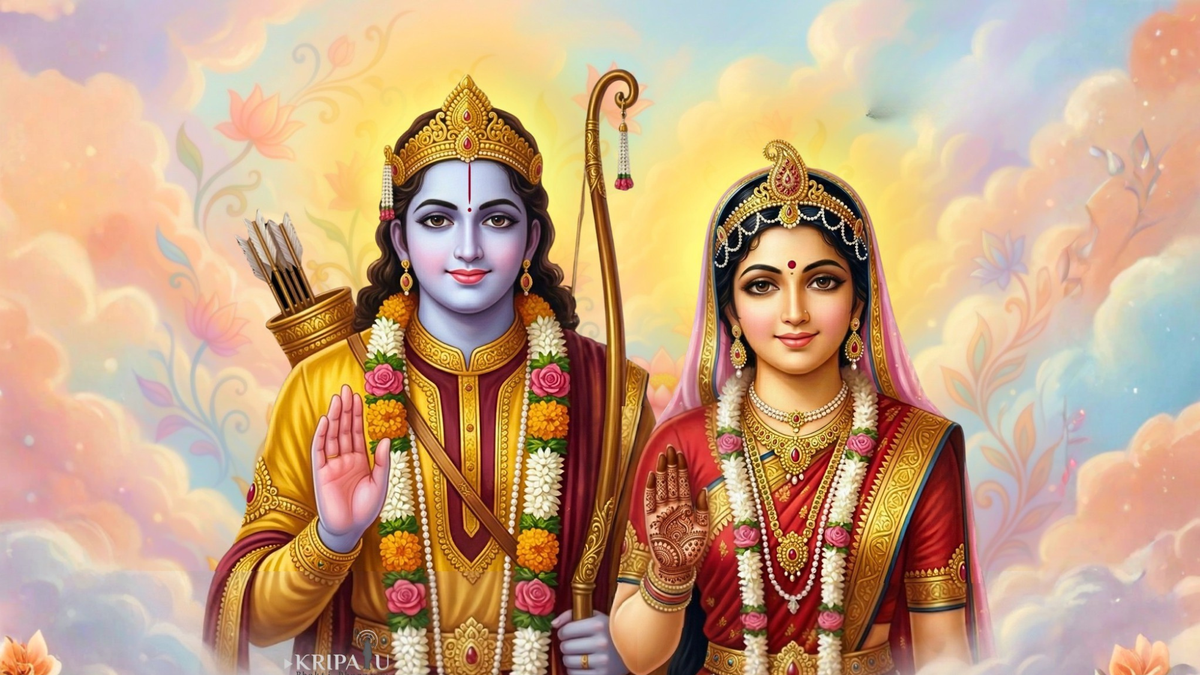
Today is the sacred festival of Ram Navami, the day when Lord Ram was born - it is His birthday.
The word 'janma' (birth) can be quite misleading. We have experienced birth since eternity - "Jātasya hi dhruvo mṛtyur dhruvaṁ janma mṛtasya ca" - one who is born will surely die, and one who goes through the cycle of birth and death is considered to be bound by Maya. But no doubt will remain if we understand the true meaning of the word janma.
"Jani prādurbhāve" - The word janma comes from the root jani, which means prādurbhāv or appearance. Janma means to appear, not to be created.
That which is newly created must eventually come to an end. Nāstato vidyate bhāvo nābhāvo vidyate sataḥ - If anything has a beginning, it must also have an end.
But the entity called 'I' has neither a beginning nor an end. It has no origin - the soul is unborn, the Supreme Soul, Paramatma, is unborn, and Maya is also unborn. All three - Atma, Paramatma, and Maya - are beginningless, endless, eternal, and divine.
We, too, appear in our mother's womb - we weren’t always there in it. After conception, we came into our mother's womb. We entered the body - this body was formed one day in the womb. It had a beginning, and therefore, it will end one day.
But 'I' was not created in the body - I came from outside and will go back outside.
"Vāsāṁsi jīrṇāni yathā vihāya" - Just as we change clothes daily, similarly, this body is also a garment for our soul. Changing clothes does not change the body; changing the body does not change the soul. The soul is eternal, unborn -
"Ātmā nityo’vyayaḥ śuddha ekaḥ kṣetrajña āśrayaḥ. Avikriyaḥ svadṛg heturvyāpako’saṅgyanāvṛtaḥ."
These are the twelve characteristics of the soul.
So when we too appear, what doubt can there be about God? He certainly appears (out of grace) - bhaye prakaṭ kṛipāla.
These processes are similar for us and for God -
- We appear, and God also appears.
- We come from somewhere and then go elsewhere, and God also comes from somewhere and then goes elsewhere.
But just as a jailer, minister, or king enters a jail freely, oversees everyone inside, ensures their safety, and then returns to their destination, God also comes in a similar manner. We, however, come bound like prisoners. That is the only difference.
There are other differences between God and us -
- God is the controller of maya, while we are controlled by maya.
- God's body is divine, and He Himself is divine; whereas we are divine, but our body is material.
- We come into this world for our own welfare, and He comes to this world for the welfare of all beings.
Why does Ram assume a form?
For Parānugraha - the welfare of souls. Every action of God is for the welfare of living beings - memorize this sentence.
Why did He create the universe? "Mukhyaṁ tasya hi kāruṇyaṁ" - He felt compassion towards all souls lying dormant in His cosmic form, in a suspended state. He thought, "Let Me manifest them in the world so they can practice devotion, attain Me, come to My abode, and eternally enjoy My knowledge and bliss, and experience eternal sweetness."
For one who has nothing to attain, their actions have no other cause. Every action of ours is for ourselves alone, while every action of God and saints is always for others. Why? Because they have nothing left to attain, no goal, no objective - so either they do nothing, or if they do something, it is only for our sake.
Although many kinds of divine actions have been described, compassion is hidden in all His actions.
Why does He destroy demons? So that the devotional practice of His devotees is not disturbed - this is grace.
Why does he manifest the Vedas? Grace.
Creating the gross elements - earth, water, fire, air, and space - for us to function is also grace.
We cannot even fathom the extent of His compassion toward us.
"Dvā suparṇā sayujā sakhāyā samānaṁ vṛkṣaṁ pariṣasvajāte. Tayoranyaḥ pippalaṁ svādvattyanāśnannanyo abhi cākaśīti."
"Two birds, companions who are always together, reside in the same tree. One (the soul) eats the fruit, while the other (the supreme soul) is mighty. He does not eat the fruit; He simply keeps observing the first bird and notes down what it does.
This one Vedic mantra portrays our relation with God so clearly -
- Sājātya - God is of the same species as us - suparṇā - He too is a bird, we too are birds (metaphorically speaking) - We belong to the same kind. We are related because we belong to the same species.
- Sakhya - He is our friend. In this world, no one can truly be anyone’s friend. All friendship is based on self-interest - the less the self-interest, the weaker the friendship, and friendship ends when there is no self-interest. God, however, is such a friend that without our asking, He gives us the fruits of actions from countless past births. He remains with us constantly, never leaving us even for 1/100th of a second. If He were to leave, the consciousness of the soul - its very essence - would cease to exist.
"Cetanashcetānānāmeko bahūnāṁ yo vidadhāti kāmān" - God constantly resides with us, sustaining the soul with life-force. God gives consciousness to the soul, the soul gives consciousness to the intellect, the intellect gives it to the mind, and the mind gives it to the senses - we function in the world through this chain. Such is our friend. - Sādeshya - Samānaṁ vṛkṣaṁ - The individual soul and the Supreme Soul both reside in the same tree, in the same branch - we are from the same place (sādeshya) - Both live in the heart together. "Ya ātmāni tiṣṭhati" - The soul resides in the heart, and within the soul resides the Supreme Soul. His beneficence toward us is infinite - no one can fully write, think, or speak of it. Such is our well-wisher. That well-wisher is Ram.
That God has three names: 1) Brahm, 2) Paramatma (Supreme Soul), and 3) Bhagavan (God).
But there are distinctions between the three. Brahm cannot be called Paramatma, but Paramatma can be called Brahm. Paramatma cannot be called Bhagavan, but Bhagavan can be called Paramatma or Brahm. This means Bhagavan is primary. His second form is Paramatma, and the third is Brahm.
Therefore, all three terms can be used for Shri Krishna and Ram.
"Yo ha vai Rāmacandraḥ sa Bhagavān" - This Ramchandra of Ayodhya is Bhagavan.
"Ardhamātrātmako Rāmo brahmānandaikavigrahaḥ" - Ram is Brahm.
"Rāmatvaṁ paramātmāsi saccidānanda vigrahaḥ" - Ram is Paramatma.
"Rāma eva paraṁ brahma Rāma eva paraṁtapaḥ Rāma eva paraṁ tattvaṁ Śrī Rāmo brahmakārakaṁ"
The personality known as Bhagavan is the Saguna (with qualities), Sākāra (with form), and possesses name, form, pastimes, qualities, abode, and associates.
One who has no pastimes or associates - only name, form, and qualities - is called Paramatma.
And one who has no name, form, pastimes, qualities, abode, or associates - is called Brahm.
"Kartā sarvasya lokasya" - Ram created the universe. He is the creator of the world. Brahma is generally referred to as the Creator, but Brahma himself says, "I did not create the world - He is the creator - Ram."
The Vedas say - "Yato vā imāni bhūtāni jāyante, yena jātāni jīvanti, yat prayantyābhi saṁviśanti, tad brahma vijijñāsasva." "That from which all beings are born, by which they live, and into which they merge - is Brahm."
Vedanta says the same - "Janmādyasya yataḥ" - The one from whom everything is born.
In the Bhagavatam, there is a beautiful verse about God -
"Na cāntarna bahiryasya na pūrvaṁ nāpi cāparam. Pūrvāparaṁ bahiścāntarjagato yo jagacca yaḥ."
This verse defines Ram and Krishna - the one who has neither inside nor outside. We have both. Every object has something inside and something outside. But God has neither an inside nor an outside.
"Na pūrvaṁ nāpi cāparam" - No one existed before God, and no one will remain after Him.
"Pūrvāparaṁ" - God existed before all and will exist after all.
And He resides within everything and outside everything.
"Jagacca yaḥ" - This visible universe is all God Himself.
The meaning of this definition is - everything is Brahm - "Vāsudevaḥ sarvamiti."
God created countless universes, He pervades them, and they dissolve into Him. He created them, and the material from which something is made remains in the thing created.
For example, an earthen pot is made from clay; clay remains in the pot - only then can the pot exist.
So the original form of the pot is clay - clay is the cause, the pot is the effect.
The cause (clay) pervades the effect (pot).
However, the function of a pot cannot be served by the cause alone. If someone goes to buy a pot and is told, "Take clay instead - the pot is made of clay anyway," they will reply, "I need to drink water, I need a pot - I cannot drink from just clay."
That is, the pot is the effect; it contains the cause.
However, the cause does not contain the function of the effect. Clay does not serve the purpose of a pot, but if someone gives us a pot, we also receive the benefit of the clay.
In this way, the universe is an effect created from God, who is the cause. So, He pervades it. Even after creation, He remains all-pervading.
When the pot breaks, it returns to its cause, the clay. So it will become clay again. So, just as the pot is essentially clay, the universe is essentially God.
But God is the embodiment of bliss - "Ānando brahmeti vijānāt," "Raso vai saḥ" - then why is there no bliss anywhere in the world?
God has hidden His blissful form.
Take fire, for example - we sit in the light but don't burn. Fire burns, and one of its properties is to emit light. But we don't burn. When material fire has two properties - burning and illuminating - and we can experience both, then the divine God also has two properties - concealing bliss and manifesting bliss.
In Golok, abundant bliss overflows everywhere, while in the universe, bliss has been hidden.
It’s not that there is no bliss in the world, because God is all-pervading and He is bliss, but we cannot experience it.
Just as a person with jaundice sees white objects as yellow, similarly, saints see Sita-Ram in the entire world (nija prabhumaya dekhahiṃ jagat), and the jnani sees Brahm everywhere, whereas once they saw the world as Maya.
So the problem lies in the dominance of maya within us - our senses, mind, and intellect are faulty. There is nothing wrong with the world itself.
In this very world, God and saints come and always remain blissful. And in the same world, we too live - but no matter how much of the world is given to us, we remain perpetually disturbed and unhappy.
And it’s not just one or two disturbances - there is no count of the kinds of disturbances - they are countless.
And when we see someone above us, we start burning with envy. We don’t think about those who are below us. When even Indra looks toward Brahma with envy, what can be said of humans?
Thus, God is everywhere, and therefore bliss is also everywhere. But in this world, there are two entities - one is inert (like earth, etc.) and the other is conscious (like us humans), and that blissful Supreme God pervades both. The combination of these three is called the world.
God also has three aspects: 1) God Himself, and His two powers: 2) Para Shakti (the individual soul), and 3) Apara Shakti (Maya).
The soul also possesses these three aspects: 1) We, the soul, 2) God residing within us, and 3) Maya - we are under its control.
This is the triad.
Each of these resides in the other, but the soul and Maya are under the control of God. Maya is under the control of God, and the soul is under the control of Maya.
If the soul transcends the subordination of Maya, it will remain a servant of God, under His control. The soul can never be completely independent. At present, it is a servant of Maya. If it becomes free from Maya, it will become a servant of God. Being a servant of Maya results in sorrow, unrest, the cycle of 8.4 million life forms, and various ailments - the three gunas, three karmas, three doshas, five afflictions (panchklesha), five sheaths (panchakosha), and so on.
On becoming a servant of God, one receives all of God’s property - divine bliss and divine knowledge. Therefore, a wise person seeks to end the bondage of Maya and desires the servitude of God.
So Ram is the creator of the entire universe. When any soul attains Ram, then - Jānata tumhahi tumhai hoi jāī - by knowing Ram, one becomes like Ram.
Becoming like Ram - this is also true.
But one cannot become equal to Ram - this too is true.
Why?
Because the things Ram possesses - infinite power, infinite knowledge, and infinite bliss - you will receive these for eternity. In that sense, you become equal to Ram.
But - Jagadvyāpāravarjam - Ram Himself does the act of creation. He does not entrust this task to any saint. Creating the world, sustaining it, and dissolving it - God does these tasks Himself. This reveals the difference between God and a saint.
Although there are thousands of definitions of God, such as He is Brahm, Paramatma, Bhagawan and the Lord of Maya, the most prominent definition of Godhood is - "Kartā sarvasya lokasya" - Ram is the creator of the universe - creating, protecting, and dissolving the creation - this is God's primary work.
"Bhogamātra sāmyaliṅgācca" - the individual soul is equal to God in terms of enjoying divine bliss, but God never delegates the act of creation to a saint, nor would any saint desire such a burdensome task. When we get so troubled just managing a few people in our household, imagine what it must be like to keep track of all the impure thoughts of every soul bound by Maya. Yet, God thinks, "This grace is My seva, it is My habit - these are My children. Whatever they think, I must note. And I must also punish them so that they can improve."
No mother shows mercy when her child walks the wrong path - she slaps the child if he steals or lies. Thus, the punishment she inflicts is also an act of mercy, as she wants her child to become a good person.
Similarly, when God punishes us through destiny (prarabdh), we protest, "God, what wrong have I done to You?" You did not harm God; rather, you have ruined your own deeds. God simply gives you the results of your actions. He neither adds nor subtracts anything from His side.
So, what is our relationship with Shri Ram?
He is our soul, and we are His body, just as our physical body, made of five elements, belongs to our soul. Such is the depth of this relationship. A body is naturally a servant of the soul within. Our body serves us, the soul, twenty-four hours a day. If we think, "I'm tired of lying down, get up," our eyes open immediately. If we tell our body to sit, it sits. If we tell our feet to walk, they walk. Not a single servant of our soul - be it the senses, mind, or intellect - ever rebels or disobeys our command, because this body belongs to the soul.
Similarly, the soul too -
"Jīva bhavadāṅghri-sevak, dāsabhūtam idaṁ tasya jagat sthāvara-jaṅgamam. Śrīmannārāyaṇaḥ svāmī jagatāṁ prabhurīśvaraḥ॥"
All souls are servants of God. And not just servants -
"Divyo devo eko Nārāyaṇo mātā pitā bhrātā nivāsaḥ śaraṇaṁ suhṛd gatiḥ"
All our relationships are with God - all our bonds are only with Ram.
That is why Lakshman said -
"Guru pitu mātu na janahu kāhū, moreṁ sabai ek tumha swāmī. Dīnabandhu ur antarayāmī॥"
Ram said to Lakshman, "I speak as your elder brother. Look, our father is aged and grieved by our separation. Parents are the most important of all. Serve them - this is your duty, your dharma. Obey it."
To this, Lakshman replied, "Maharaj, don't teach me this deception. Bhrātā bhartā cha bandhuścha pitā cha me Rāghava - You alone are my mother, my father, my friend, my master. The soul's only relationship is with the Supreme Soul."
Ram fell silent and allowed Lakshman to accompany Him, thinking, "Lakshman is wise. It is impossible to fool him." It is God's habit - He tries to fool everyone.
"Kāgabhushundi māṅgu vara animādika siddhi apara ridhi mokṣa sakala sukha khān॥"
Lord Ram said to Kagbhushundi, "I am very pleased with you - ask for the anima and other siddhis (mystic powers), ask for liberation - but Kāgabhushundi hung his head in disappointment. God wants to deceive. Shri Krishna does not want to give devotion - He is ready to give everything else.
Kāgabhushundi said -
"Aviral bhakti viśuddha tava, śruti purān jehi gāv. Jehi khojat yogīs muni, prabhu prasād kou pāv॥"
"Please grant me devotion - I don't want these material enjoyments or liberation."
Similarly, God tried to deceive the gopis - He told them, "Go fulfill your duties as devoted wives." This is God's habit. But a wise person does not fall for God's smooth talk.
So, all relationships are with God - what is our sadhana?
Accepting those relationships alone is our practice. To constantly experience those relationships deeply within.
We don't need to do anything else - not seek knowledge, perform austerities, recite scriptures, or engage in rituals. This is called bhakti - always just to accept that He alone is ours -
"Astītyevopalabdhayas tattvabhāvaḥ prasīdati"
He doesn't want anything from us - "Aiso ko udār jag māhīṁ. Binu sevā jo dravai dīn par Rām sarisa kou nāhīṁ॥"
You just have to believe.
You may ask, "What is the big deal in that?"
It is such a big deal that even after hearing it from saints and from God Himself over countless lifetimes, you have formed countless relationships - mothers, fathers, sons, daughters - and yet are not ready to accept God as your son or daughter. We even make donkeys our own, but not God's.
We've forgotten our true relative and call worldly people our close relatives.
But what does a real relationship mean?
It means someone who supports us and helps us.
But if that person cannot even control their own body or its existence, then how can they fulfill any relationship? You want to maintain ties with someone who cannot guarantee their own existence. You believe in them, accept them, and you even mourn for them when they die. But this mind is so messed up from infinite births that even after hearing and knowing everything, it does not let go of this habit.
When Abhimanyu was killed, Arjun was devastated. He begged God to let him see his son once more. Even after God explained, he didn’t relent. So God summoned that soul. When Arjun said "Son!", Abhimanyu replied, "Hey! Don’t you dare call me your son! How many times have you been my son? I left your son behind - that was the son of your body. The entity called 'I' is the soul. The soul is not your relative - not your father, nor your son. God alone is the true relative."
To strengthen this relationship with God, we must practice it repeatedly. This is called chintan, remembrance. To reinforce that remembrance, scriptures prescribe practices such as kirtan and bhajan. So that "Tvameva sarvam mama deva deva" gets firmly embedded in our intellect - that Ram alone is everything to me. To keep this thought always present, we must practice.
There is no other means - not karma, not jnana.
Just as you were born from your mother’s womb, innocent and naïve, you must become that way again -
"Mohi kapaṭ chhala chhidra na bhāvā, man krama vachan chhāḍi chaturāī. Bhajata kṛpā karihaiṁ Raghurāī॥"
You must return to that old state again. All the confusion you have accumulated throughout your life will have to be removed and thrown away. Just as you put in the effort to collect all this, now work just as hard to remove it. This is called vairāgya (detachment) and abhyāsa (practice).
Thus, purify your mind by meditating on Ram, singing and remembering His name, form, pastimes, qualities, and worshiping Him with selfless love. Then, through the grace of the Guru, you will attain that love for Ram.
Then, through that love, the veil of Maya will be lifted, you will attain supreme bliss, and your true self will be revealed.
Therefore, the purpose of celebrating Ram Navami should be to strengthen our true relationship with Ram through repeated contemplation, remembrance, and kirtan.
Each Ram Navami, we should evaluate ourselves - how much detachment from the world have we developed and how much attachment to God have we gained since the last Ram Navami? If we haven't gained anything, we must feel the loss and prepare for the next time.
By practising.
like this, when we reach the state where He alone is our everything, we will find him standing with both arms stretched out - He doesn't need to come from anywhere, nor do we need to perform any practice to call Him - He is already ready.
Just empty the room - two opposing things cannot coexist in the same space - either love the world or love God and the saints - both cannot remain together. This is God’s condition - you must become exclusive (ananya).
Understand all these, practice them, and attain your goal.
Recommended books by Jagadguru Shri Kripalu Ji Maharaj related to this topic: