The Playful Mystery of Braj: A Basant-Leela of Divine Laughter
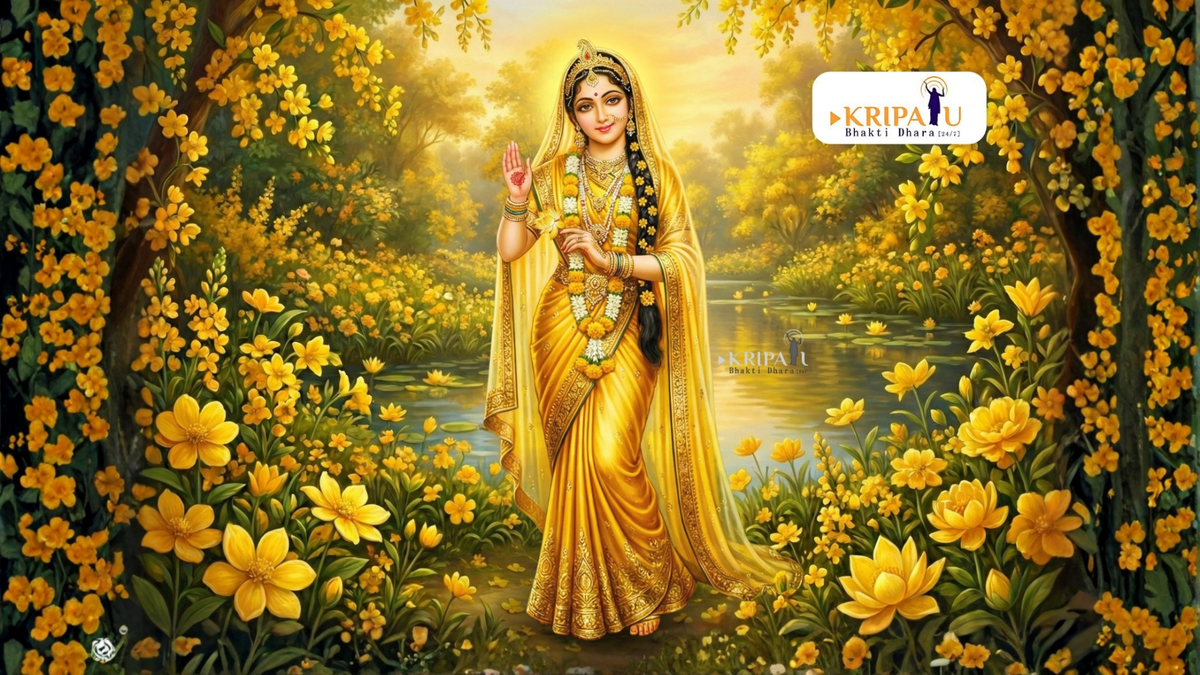
The Basant-leela is based upon playful humour and hāsya-rasa (divine laughter). It illustrates the playful, incomparable nature of the residents of Braj, where even Indra, the King of the Gods, is humbled by the simplicity and wit of the rasik saints.
The leela begins in the heavenly abode of Indra, where a grand competition of laughter is organised. Two jesters are invited, and they make the entire assembly burst into laughter. Narad Ji is also present in the court, yet he remains serious and composed. Perplexed, Indra asks him, "Everyone here is rolling with laughter. Why are you so serious when your very nature delights in humour and wit?”
Narad Ji smiles gently and replies, "Indra, I do not find joy in the mundane jokes of the world. My laughter is reserved for the divine and humorous pastimes of God. The soul wanders restlessly in search of bliss, whereas all bliss exists in God alone. The gopis and gopas of Braj are the true masters of hāsya-rasa, and Krishna Himself is supreme in this rasa. It is only upon witnessing His leelas that true laughter arises."
Hearing this, Indra develops a longing to behold that hāsya-rasa for himself. Disguising themselves as wandering Baba Jis, Narad Ji brings Indra to Braj.
Upon reaching Nandgaon, they witness a curious scene. Two children, each about five years old, are fighting. One is fair-complexioned, from Barsana, and the other is dark-complexioned, from Nandgaon. They wrestle, shout abuses, and strike each other. The dark-complexioned child is stronger and throws the fair-complexioned one to the ground.
Frustrated, the fair boy cries out, "I will complain to Nandalal about you! You have no manners. Your Master sings the glories of Barsana, yet you treat me with such disrespect! Thakur Ji speaks to me with folded hands, and you dare to push me?" The dark child drags him even more roughly.
Seeing this, Indra rushes forward to intervene. The dark child now threatens the fair one, saying that he will break all sixty-four of his teeth with a single punch. Laughing, Indra replies, "Child, humans have only thirty-two teeth. How will you break sixty-four?"
The boy retorts, "I have added your thirty-two to his in my calculation!"
Enraged, Indra grabs the child by the ear. Instantly, the fair boy jumps onto Indra's back to defend his friend. Together, the two children overpower the King of the Gods, making him appear utterly foolish. At that moment, Narad Ji reveals himself and gently admonishes the children, saying, "How can you treat a Baba like this, being Brajwāsīs?" The children bow respectfully and reply, "Narad Ji, we know very well that he is Indra."
Indra stands frozen. How did these toddlers see through his disguise? Narad Ji then explains, "Rasik saints reside in Braj. Only a rasik can understand the words, actions, and gestures of a rasik. Do not try to reason it out. Understanding will come as you hear more divine pastimes."
The dark boy then says, "In Braj, we fight and laugh like this - quarrelling one moment and embracing the next. Yesterday, Thakur Ji threw away a half-eaten mango. It fell once in Barsana and once in Nandgaon. I belong to Nandgaon, while he belongs to Barsana, and we both ran to claim it. That sparked the fight." The boys know the immeasurable value of God's jūṭhan-prasād. It is an ocean of divine bliss, and it is the very wealth for which they live.
They then reveal their true identities as the Gram Devtās, the village deities, of Nandgaon and Barsana. They explain, "We have served as Brahma countless times. In one day of Brahma, fourteen Indras change. God may be your father, but the Brajwāsīs are even the fathers of God Himself. Once, the Lord asked us to seek a boon, and we asked only for the sentiments of Braj, for love imbued with mādhurya-bhāv."
Indra begs forgiveness and requests to hear more pastimes of Braj. The children begin narrating several leelas.
The first concerns the sakhās. There was a calm-natured sakhā of Shri Krishna named Chandan, who was born into a Brahmin family. His father, Bhushan Pandit, serves as the family priest in Thakur Ji's household. Chandan regards his father as his ishta-dev and Thakur Ji as his sakhā. He never became angry with Thakur Ji.
Desiring to increase the bliss of the leela, Krishna decides to provoke him. During a game, the gopa Mansukh
strikes Krishna on the back. Krishna begins to wail in feigned agony. While the other boys scold Mansukh, Chandan remains calm and urges everyone to speak with love.
Yet Thakur Ji deliberately teases Mansukh further, escalating the quarrel. Mansukh then provokes Chandan by claiming that Thakur Ji has insulted his father. Chandan remains calm at first, but when the accusation is repeated, he becomes enraged and runs toward Thakur Ji with a stick. Lakshmi Ji and Brahma intervene, but Chandan does not stop. Finally, Mansukh himself steps forward and receives the blow. Everyone, especially Thakur Ji, is distressed. Thakur Ji then pacifies Chandan, saying that He cannot live without him. In the end, all embrace one another amid laughter and love.
The second leela concerns a young girl whose parents begin speaking of her marriage and tell her to abandon play, while her friends still regard her as a child. Confused and sorrowful, she goes to the banks of the Yamuna to throw away her toys. She has heard whispers of a ghost who haunts the riverbanks - a ghost so handsome that anyone who sees him becomes "possessed" by him. That night, she goes to the riverbank, and as the crickets chirped and the leaves rustled, a voice behind her said, "Ha! Ha!" The girl faints in fear. When she awakens, she sees a boy of incomparable beauty and becomes enchanted. "Are you the handsome ghost?" she asks innocently. "Please possess me too!"
Krishna laughs and replies, "If I possess you, I will never leave. Go home and play with your dolls, or you will find yourself in great trouble!"
In the third leela, the boys reveal that great exalted beings come to Braj in the form of sakhīs. One such sakhī came at night to Nandmahal to behold Thākur Ji. Feigning sleep, Krishna suddenly reaches out, pulls her close, and places His hand upon her racing heart to calm it, embracing her in mādhurya-bhāva. When Yashoda Maiya arrives in the morning, Thakur Ji effortlessly manages the situation with a simple pretext. Later, as the sakhī departs, she looks at her chest and sees the name “KRISHNA” imprinted there in divine radiance. Overcome with ecstasy, she faints. She was none other than sage Durvasa, who had come to taste this ras.
Finally, the boys narrate their leela of playful restlessness. Narad Ji arrives in sakhī-bhāv, disguised as a yoghurt-selling gopi. Krishna enchants her with His flute, blocks her path, accuses her of stealing the music of His flute, and demands a toll tax. She runs to complain to Radha, saying, "Your future husband is a thief! He tore my saree and teased me. Think twice before marrying such a character!"
When Radharani investigates, she finds Shri Krishna sitting dejected, looking like the victim himself. "A strange girl harassed me," He claims. Being the embodiment of innocence, Radharani believes Him. Narad Ji thus successfully deepens the ras of the divine couple, and their playful banter transforms the complaint into a celebration of love.
A sakhi then sings the song "Braj ki reet nirāli hai" signifying that the ways of Braj are unique, and the leela concludes with the joyous dance of Holi.
This leela makes it clear that the laughter of Braj is not ordinary. It is the direct manifestation of pure love and divine ras. Here, even quarrels are expressions of affection, even harsh words are soaked in intimacy, and laughter itself becomes an act of devotion. Through the playful joy of Basant, this leela gently yet profoundly reveals the deepest principles of ras and the inner mystery of Braj-bhāv, where every action, every emotion, every smile, and every tear flows only toward divine love.
For the devotees of mādhurya-bhāv, it is always Basant - the spring season - throughout the year, when divine love perpetually blooms.
Recommended books by Jagadguru Shri Kripalu Ji Maharaj related to this topic: